



Manufacturing Process and CPU Architecture
Apple and Qualcomm take different paths when translating transistor counts into laptop performance. Apple builds the M4 on TSMC's second-generation 3-nanometer node, which the company calls N3E. This fabrication advantage allows Apple to pack more transistors per square millimeter while maintaining reasonable power envelopes. The tighter process geometry contributes to better energy efficiency per operation, though the actual performance depends heavily on how Apple allocates those transistors across the chip's functional blocks.
The base M4 ships with an 8-core CPU configuration split between 4 performance cores and 4 efficiency cores. Apple designed the efficiency cores to handle background tasks and lighter workloads with minimal power draw, while the performance cores engage when applications demand sustained multi-threaded throughput. This heterogeneous approach mirrors smartphone chip design philosophy, letting the operating system route tasks to the appropriate core type based on complexity and power sensitivity. For users running browser tabs, email clients, and streaming services simultaneously, the efficiency cores keep fan noise absent and battery drain low. When compiling code, exporting video, or running scientific simulations, the performance cores activate without requiring the entire chip to consume peak power.
Beyond the base M4, Apple offers M4 Pro and M4 Max variants. The M4 Pro scales to a 14-core CPU, adding more performance cores for workstations handling professional creative workflows. The M4 Max reaches a 16-core CPU configuration, positioning it against desktop replacement territory where single-chip performance rivals dedicated workstation GPUs from previous generations.
Qualcomm takes a different architectural approach with the Snapdragon X Elite. Built on a 4nm process, the node geometry is coarser than Apple's 3nm, which affects transistor density and power efficiency at equivalent clock speeds. Qualcomm equips the platform with a 12-core Qualcomm Oryon CPU, abandoning the big.LITTLE heterogeneous core arrangement in favor of a homogeneous core design where all cores share similar capabilities and power characteristics.
The Oryon architecture targets sustained performance across all cores rather than routing tasks based on workload intensity. This matters for developers running containerized Linux environments, data analysts processing large datasets in memory, and professionals who keep multiple virtual machines active simultaneously. With all cores capable of hitting peak frequencies, the Snapdragon X Elite avoids the scheduling complexity that heterogeneous designs require.
Qualcomm offers three distinct SKU tiers within the Snapdragon X Elite family. The X1E-00-1DE represents the full configuration with highest clock speeds and cache allocation. The X1E-80-100 and X1E-64-100 variants scale down core frequencies and L3 cache to hit lower price points while maintaining the same fundamental architecture. OEMs choose which SKU to implement based on thermal headroom and target battery life for specific laptop designs.
The architectural divergence reflects each company's target user. Apple's efficiency-core approach optimizes for the typical laptop usage pattern where most time is spent on light tasks. Qualcomm's all-performance-core design assumes users more frequently push all available cores toward demanding workloads. Neither approach is objectively superior; the right fit depends on how you actually use a laptop throughout a typical workday.
AI Performance and NPU Capabilities
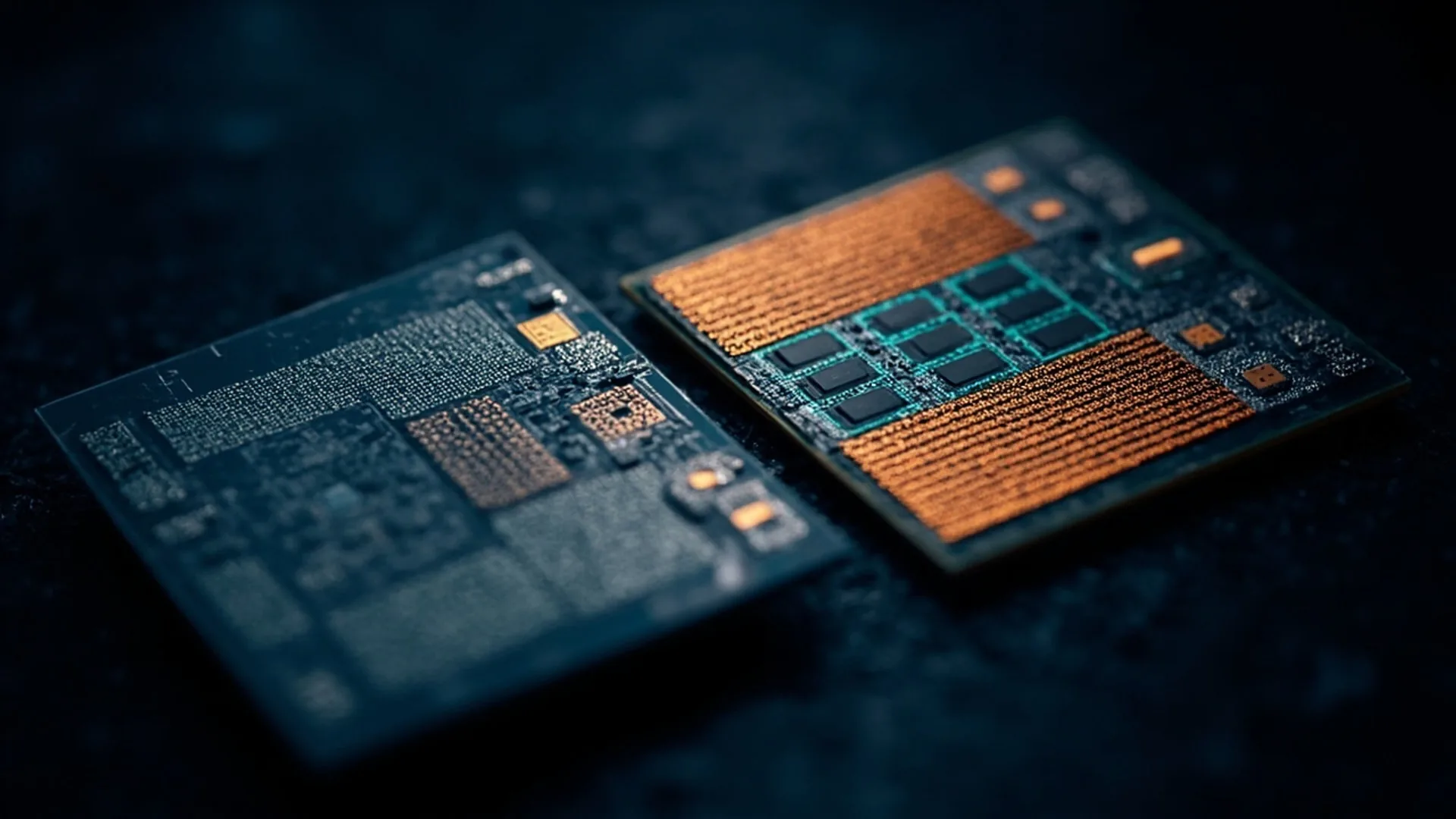
Artificial intelligence workloads have become a defining metric for modern laptop processors. Both Qualcomm and Apple embed dedicated neural processing units designed to accelerate machine learning tasks, but their approaches differ substantially in architecture and capability.
Apple's M4 integrates a 38-trillion-operations-per-second Neural Engine directly into the system-on-chip. This dedicated hardware block handles tasks ranging from real-time speech recognition to image segmentation in Photos and video analysis in Final Cut Pro. The unified memory architecture allows the Neural Engine to access model weights without copying data across separate memory pools, which reduces latency during inference operations. Apple's machine learning framework, Core ML, compiles models to run on this Neural Engine alongside GPU compute cores when additional throughput is necessary.
Qualcomm's Snapdragon X Elite pairs a 45-TOPS Hexagon NPU with the Oryon CPU architecture. The higher TOPS figure represents raw acceleration potential, though actual performance depends heavily on workload characteristics and software optimization. Qualcomm designed this NPU to meet Microsoft's Copilot+ PC specifications, which require at least 40 TOPS for certain on-device AI features. The platform supports Windows Studio Effects for background blur and eye contact correction during video calls, voice focus during transcription, and live caption translations. These features operate locally without cloud connectivity.
The software ecosystem determines how effectively each platform deploys its AI silicon. Apple Silicon benefits from five years of developer optimization. Applications built for M-series chips automatically route machine learning tasks to the most efficient hardware block. Qualcomm's Snapdragon X Elite requires more deliberate software selection. Native ARM64 applications unlock the full NPU potential, while x86-64 applications running through emulation cannot access AI acceleration features. Microsoft's Windows ML API provides a cross-vendor abstraction layer, but developers must explicitly target NPU execution providers rather than relying on automatic fallbacks.
For users evaluating these platforms, the TOPS comparison alone does not tell the complete story. Apple delivers a mature, integrated ecosystem where AI features function consistently across native applications. Qualcomm offers competitive raw specifications and the Copilot+ integration that Windows users specifically value, but the experience depends on application developers prioritizing ARM64 optimization. Content creators running Adobe's Creative Cloud suite, for example, will find more predictable AI acceleration on Apple Silicon because Adobe invested early in Metal GPU acceleration for Mac. Professional users on Windows ARM machines should verify that their specific applications support native NPU access before assuming full AI capability.

| Field | Apple M4 | Snapdragon X Elite | Edge |
|---|---|---|---|
| Process | TSMC N3E (3nm, 2nd-gen) | 4nm | Apple (tighter node) |
| Base CPU config | 8 cores (4P + 4E) | 12-core Oryon (all performance tier) | — |
| Max CPU cores | 16 cores (M4 Max) | 12 cores | Apple (more cores) |
| NPU TOPS | 38 TOPS (Neural Engine) | 45 TOPS (Hexagon) | Qualcomm (meets Copilot+ 40 TOPS) |
| NPU platform fit | Apple Intelligence + Core ML | Copilot+ PC + Windows Studio Effects | Different ecosystems |
| Memory architecture | Unified (CPU/GPU/NPU shared) | System cache + LPDDR5x | Apple (lower latency) |
| Software maturity | 5 years of M-series optimisation | Requires ARM-native Windows apps | Apple (broader native support) |
Memory, Graphics, and Power Efficiency
Apple and Qualcomm take different approaches to memory architecture, and those differences shape how each platform handles demanding workloads. The M4 chip accesses up to 64GB of unified memory with a bandwidth of 120GB/s, meaning the CPU, GPU, and Neural Engine share the same pool without copying data between separate memory banks. This unified design reduces latency during operations that require the processor, graphics, and machine learning cores to work on the same data simultaneously. The Snapdragon X Elite uses LPDDR5x memory with a maximum capacity of 64GB but delivers 136GB/s of bandwidth, giving it a measurable advantage in memory-intensive tasks such as large dataset processing or high-resolution video editing where moving large amounts of data quickly matters most.
The GPU architectures reflect each company's target use cases. Apple designs its GPU for tight integration with the unified memory system, enabling efficient sharing of data between the processor cores and graphics operations. The M4 GPU includes hardware-accelerated ray tracing, a feature originally associated with discrete graphics cards but now available in integrated silicon. Apple lists the M4's display support as one internal display plus up to two external displays at 6K resolution and 60Hz refresh rate, which covers most professional workstation configurations involving dual monitors or an external display alongside the built-in screen.
Qualcomm's Adreno GPU in the Snapdragon X Elite also supports hardware-accelerated ray tracing. The company positions its graphics capability for both productivity and casual gaming scenarios on Windows. External display output through the platform varies by OEM implementation, as laptop manufacturers choose different port configurations and display controller specifications. Users who require specific multi-monitor setups should verify the exact capabilities of their chosen Snapdragon X Elite laptop model rather than assuming platform-level maximums.
Battery life claims reveal the practical impact of each architecture's efficiency focus. Apple states that the MacBook Air with M4 delivers up to 18 hours of battery life during video playback. Microsoft specifies up to 22 hours for the Surface Pro 11th edition with Snapdragon X Elite under its defined testing conditions. Battery life on other Snapdragon X Elite laptops varies significantly by OEM implementation, thermal design, screen size, and battery capacity. Both manufacturer figures represent results under controlled lab conditions, and real-world usage varies based on workload, screen brightness, and network activity. The gap between these numbers reflects differences in architecture optimization and operating systems' power management strategies rather than a simple judgment of which platform is superior.
Power efficiency ultimately depends on workload distribution. Tasks that stay within the Neural Engine or media engine domains on M4 consume less energy than those requiring the full CPU cluster. Similarly, Snapdragon X Elite directs AI workloads to its Hexagon NPU to preserve battery life during extended use. Understanding which tasks your daily workflow emphasizes determines which platform's efficiency characteristics matter most for your situation.

Ecosystem, Connectivity, and Software Reality
The software ecosystem surrounding each platform shapes daily usability far more than raw specifications. Qualcomm built Snapdragon X Elite around Windows 11 ARM, which Microsoft documented as supporting both native ARM applications and x86-64 emulation for legacy software. This dual compatibility means most existing Windows programs run immediately, though with performance trade-offs. Microsoft's documentation confirms that x86-64 emulation adds computational overhead, while native ARM64 applications deliver optimal efficiency.
Apple Silicon takes a different approach through Rosetta 2, which Apple introduced with the M1 generation. This binary translation layer converts x86-64 instructions for Intel-based Mac applications into ARM instructions the M4 executes natively. The translation happens at launch time rather than runtime, reducing the performance penalty compared to real-time emulation. Most professional software now ships native Apple Silicon builds, but Rosetta 2 remains essential for legacy tools and occasional plugins that developers have not yet updated.
Both platforms support Wi-Fi 7 connectivity according to their respective specifications. Apple lists the standard as 802.11be in M4 documentation, while Qualcomm's FastConnect system for Snapdragon X Elite includes Wi-Fi 7 as a platform feature. This parity means wireless networking performance depends more on router hardware and environmental factors than the laptop chip itself.
Port selection diverges slightly between the two. Apple's M4 specifications confirm Thunderbolt 4 support, while Qualcomm's Snapdragon X Elite implements USB4 version 2.0, which provides functionally equivalent bandwidth and feature parity for external storage, displays, and docks. The practical difference lies in cable compatibility rather than capability.
Choosing between these platforms ultimately depends on your software library. Professionals locked into Windows-specific enterprise tools, legacy applications without ARM64 builds, or specialized hardware requiring Windows-only drivers will find Snapdragon X Elite laptops more practical despite emulation overhead. Creative professionals already invested in macOS-native applications, or those relying on Apple's continuity features across iPhone and iPad, face a steeper adjustment on Windows ARM hardware. The native application landscape continues expanding for both platforms, but your existing toolset should drive the decision more than benchmark scores.



Loading comments…