
The two phones everyone will be arguing about in 2026 have both landed. The iPhone 17 Pro shipped on 19 September 2025 from $1,099 for 12GB of RAM and 256GB of storage, and the Galaxy S26 Ultra followed on 6 March 2026, priced above it and sold in one size only.[1][3] Both are the best their companies make, and a full spec comparison sits at our Galaxy S26 Ultra spec breakdown, which covers the Samsung in detail. The question is which set of trade-offs you would actually live with, and the honest answer is that the two phones optimise for different owners.
On paper the gap looks simple. Samsung goes bigger, brighter, and higher resolution. Apple goes smaller, cheaper at the entry point, and more capable on paper in the video suite. Neither company gives you everything the other does, so the decision is a matter of which absences you can tolerate.
The size and display split
The iPhone 17 Pro is 8.75mm thick and 204g, with a 6.3-inch Super Retina XDR OLED panel running at 120Hz.[1] Apple quotes 3,000 nits at peak brightness, though in measured testing GSMArena recorded 1,012 nits of maximum output.[1] The Galaxy S26 Ultra is 7.9mm thin but 214g, and its 6.9-inch LTPO AMOLED display is rated at 2,600 nits peak, with GSMArena measuring 1,480 nits in practice.[1] That measured spread is the most useful number on either spec sheet. Apple advertises a higher peak, but the Samsung panel was brighter in the lab, which matters more for everyday use than a headline figure does.
The Samsung screen also carries the new Privacy Display, which uses the Gorilla Armor 2 glass to make the image harder to read from an angle. In a cafe or on public transport that is a genuine privacy feature. At your kitchen table it is just a slightly harder-to-share screen. The iPhone instead pairs its panel with Ceramic Shield 2, which rates at Mohs level 5 against the Samsung's Mohs level 6.[1] Both have anti-reflective coatings, and both are IP68. The real choice is physical. The iPhone 17 Pro is the smaller, more pocketable device, and you do not pay for it with a worse camera system. The S26 Ultra is the one-size flagship, and the 6.9 inches stay with you for as long as you keep it.
Cameras, shot for shot
The camera lineups tell the same trade-off story in different numbers. The S26 Ultra packs a 200MP main sensor, a 50MP ultrawide, a 10MP 3x telephoto, and a 50MP 5x periscope telephoto, with a 100x Space Zoom ceiling and 8K video.[1][2] The iPhone 17 Pro answers with three 48MP cameras, a wide at f/1.78, a 4x periscope telephoto at f/2.8, and an ultrawide at f/2.2, plus an 18MP front camera on a square sensor and 4K120 video with ProRes and Apple Log support.[1] More megapixels is not the whole story, so the useful evidence is what happens when the same scenes go through both.
Amateur Photographer shot the same scenes with both phones across low light, portraits, macro, and zoom, and the verdicts are close in a way the spec sheet does not promise.[2] At 1x the two are effectively a draw, with the Samsung exposure slightly more balanced and the iPhone colours slightly warmer. The ultrawide is another draw, and the 2x digital crop off the high-resolution main sensors works well on both. The split arrives at the telephoto end. The Samsung's physical 3x and 5x lenses hold detail better than the iPhone's 4x lens at comparable framing, and at the maximum optical-quality zoom, 10x on the Samsung against 8x on the iPhone, the outlet gave the edge to the Samsung for colour and detail. At 40x and 100x digital, neither result is genuinely usable, though the iPhone's 40x at least stays somewhat watchable.
Low light is where the S26 Ultra pulled ahead most consistently in that shooting session, with better colour balance and a little more detail at 1x and on the telephotos.[2] The iPhone's portrait processing runs warmer and more flattering, at the cost of a slightly more visible subject outline if you zoom in close. The Samsung also includes a Pro mode directly in the camera app, and both record raw DNG stills. For video, the iPhone's 4K120, ProRes, and Apple Log pipeline is aimed at people who grade their footage, while the Samsung's 8K30 mode is the headline number for stills-first shooters.[1]
| Camera | iPhone 17 Pro | Galaxy S26 Ultra | Edge |
|---|---|---|---|
| Main sensor | 48MP f/1.78 wide | 200MP main | Samsung (more megapixels) |
| Ultrawide | 48MP f/2.2 | 50MP ultrawide | Samsung (resolution) |
| Telephoto 3-4x | 48MP 4x periscope f/2.8 | 10MP 3x telephoto | iPhone (longer optical reach) |
| Telephoto 5x+ | — | 50MP 5x periscope | Samsung (exclusive) |
| Max optical-quality zoom | 8x | 10x | Samsung (detail & colour) |
| Max digital zoom | 40x (still watchable) | 100x Space Zoom | Tie (neither usable) |
| Video ceiling | 4K120 + ProRes + Apple Log | 8K30 | iPhone (for graders) |
| Front camera | 18MP square sensor | — | iPhone (uniqueness) |
| Pro / RAW mode | Pro mode, DNG raw | Pro mode in app, DNG raw | Tie |
| Low-light verdict (Amateur Photographer) | Warmer, more flattering portraits | Better colour balance, more detail | Samsung |
Battery, charging, and the S Pen
The S26 Ultra carries a 5000mAh battery and charges over the wire at 60W, reaching 75% in 30 minutes. The iPhone 17 Pro splits its cell by market, 3998mAh in the Nano SIM version and 4252mAh in the eSIM-only version, and charges at 40W to 50% in 20 minutes.[1] Wireless is a tie on paper, with both phones supporting 25W Qi2 charging, and both can do a small amount of reverse wireless for accessories. In a morning routine the Samsung reaches a full working charge faster, and the extra capacity gives it more headroom on heavy days. The iPhone's faster 50% time is the better spec if your habit is a short top-up, but the raw battery margin sits with the S26 Ultra.
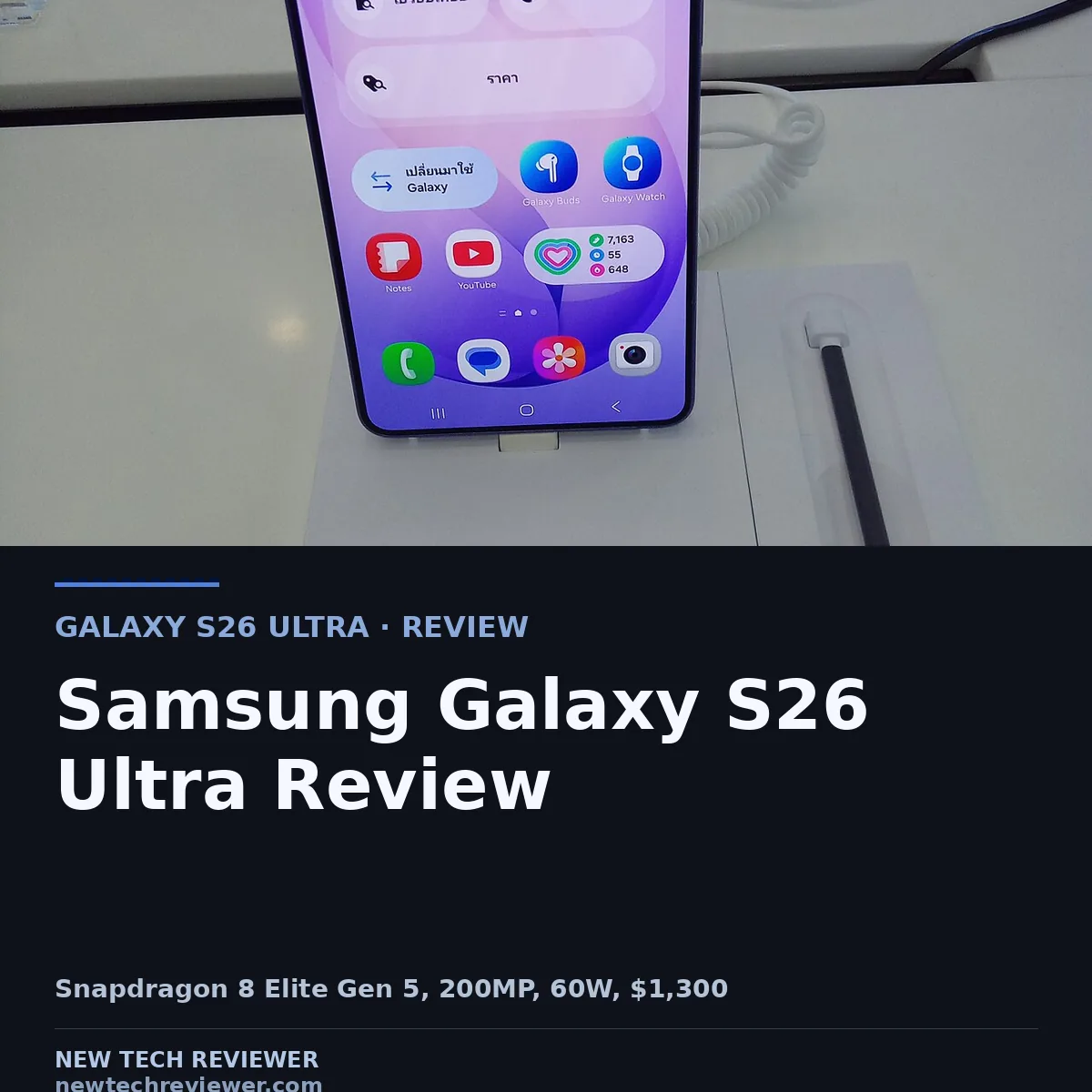
The S Pen is the feature that has no Apple equivalent, and it is included in the box. For notes, sketching, and marking up documents, a stylus in the chassis changes what the phone is used for. The iPhone's answer is the Camera Control button, which the S26 Ultra does not have, though in the hands-on comparison the reviewer noted that the button is a feature they personally never reached for.[2] If you do not draw or annotate, the S Pen is a spec line you will ignore. If you do, it is the clearest reason to pick the Samsung.
| Field | iPhone 17 Pro | Galaxy S26 Ultra | Edge |
|---|---|---|---|
| Battery capacity | 3998mAh (Nano SIM) / 4252mAh (eSIM) | 5000mAh | Samsung (raw capacity) |
| Wired charging | 40W (50% in 20 min) | 60W (75% in 30 min) | Samsung (faster full charge) |
| Wireless charging | 25W Qi2 | 25W Qi2 | Tie |
| Reverse wireless | Yes (small amount, accessories) | Yes (small amount, accessories) | Tie |
| Stylus | — | S Pen included in box | Samsung (no Apple equivalent) |
| Special hardware | Camera Control button | — | iPhone (one-handed) |
Performance, and the software commitment
Both chips are 3nm flagships, the A19 Pro with a 6-core CPU and 6-core GPU on the iPhone, and the Snapdragon 8 Elite Gen 5 on the Samsung.[1] In the Geekbench comparison Tom's Guide ran, the A19 Pro's 3,834 single-core and 9,988 multi-core scores beat the S25 Ultra's 3,031 and 9,829, and the iPhone transcoded the same video in 22 seconds against 52.[4] That comparison is against the previous Samsung flagship rather than the S26 Ultra itself, but the pattern it shows, Apple ahead in CPU and sustained video work, is the one to expect at the top end. In everyday use both phones are fast enough that the difference lives in benchmarks, not in the wait for an app to open.
The software commitment is where the gap is hardest to argue away. Samsung promises up to seven major Android updates for the S26 Ultra, running Android 16 with One UI 8.5 at launch.[1] Apple ships iOS 26 and has just seeded the first public builds of iOS 27, which brings the Liquid Glass design language and the rebuilt conversational Siri, a cycle detailed in our iOS 27 roadmap breakdown. If you hold a phone for five or six years, the Samsung's seven-year pledge is the longer documented commitment, and it is the one number that should carry the most weight for a long-term buyer.
Price, storage, and resale
Neither of these is a budget phone, but the entry point is the iPhone's. The 17 Pro starts at $1,099 for 256GB, the S26 Ultra starts higher and comes in one size only, and the larger iPhone 17 Pro Max sits at $1,199 for the same storage.[2] The gap narrows as storage climbs. At 512GB the S26 Ultra is $1,449 and the Pro Max is $1,399, and at 1TB they are $1,799 and $1,599.[2] The 2TB iPhone at $1,999 has no Samsung counterpart at all, which is a real option if you shoot ProRes video and keep it on device. Resale is the other quiet factor, with iPhones tending to hold their second-hand value better than Samsungs, which matters if you plan to sell the phone rather than keep it to the end of its update life.[2]
Which trade-off is yours
The S26 Ultra is the more complete device on the spec sheet. It has the bigger display, the dual telephoto, the faster charging, the S Pen, the 8K mode, and seven years of updates. The iPhone 17 Pro is the smaller, cheaper-at-entry device with the stronger video toolset, the second size option, and the 2TB ceiling. The measured brightness numbers add a wrinkle to the display argument, since the Samsung wins in practice even though Apple quotes a higher peak.[1] There is no phone that wins every line in this comparison, and the buyer who wants one is buying a different device than the one either company made. The trade-off to decide is simple to state and personal to answer. Pick the bigger screen, the extra lens, and the longer update tail, or pick the smaller body, the lower entry price, and the pro video codecs.
Frequently asked questions
How much do the iPhone 17 Pro and Galaxy S26 Ultra cost?
The iPhone 17 Pro starts at $1,099 for 256GB, with the larger 17 Pro Max at $1,199 for the same storage, and the top 2TB model at $1,999.[2] The S26 Ultra is priced above the smaller iPhone and comes in a single size, with 256GB models starting at $1,279 and the 1TB model at $1,799.[2] Storage tiers run closer together above the entry point, with the 512GB S26 Ultra at $1449 against $1,399 for the Pro Max.
Which phone has the better camera?
Neither wins on every shot. In the hands-on session by Amateur Photographer, both produced near-identical results at 1x and on the ultrawide, the S26 Ultra took the edge at maximum optical-quality zoom and in low light, and the iPhone 17 Pro produced warmer, more flattering portraits.[2] If you zoom a lot or shoot in the dark, the Samsung is the stronger pick. If you grade video, the iPhone's ProRes and Apple Log pipeline is the deciding feature, regardless of stills results.
How long will each phone get software updates?
Samsung commits the S26 Ultra to up to seven major Android updates, on top of Android 16 and One UI 8.5 at launch.[1] Apple does not publish an equivalent multi-year pledge for the iPhone 17 Pro in the same form, and it ships with iOS 26 and upgrades through the iOS 27 cycle now in beta.[4] On the documented commitment, the Samsung is the longer bet, and that is the number to weigh if you keep a phone for half a decade.
What is the difference in charging speeds?
The S26 Ultra charges at 60W over the wire and reaches 75% in 30 minutes, while the iPhone 17 Pro charges at 40W and reaches 50% in 20 minutes.[1] Both support 25W Qi2 wireless charging and a small amount of reverse wireless. The Samsung wins a full charge in less time, and the iPhone's faster half-charge suits shorter top-ups. If you charge overnight, the difference is academic.
When did each phone launch?
The iPhone 17 Pro launched on 19 September 2025, and the Galaxy S26 Ultra was announced on 25 February 2026 and went on sale on 6 March 2026.[1] The S26 Ultra is therefore the newer device, and it has had several months of real-world use by the time the 2026 comparison season peaks. Both phones are available now in the major markets.
References
- GSMArena — Apple iPhone 17 Pro vs Samsung Galaxy S26 Ultra spec comparison (measured brightness, battery, charging, OS, launch dates)
- Amateur Photographer — iPhone 17 Pro vs Samsung Galaxy S26 Ultra. I shot hundreds of photos to find out which flagship is best (21 April 2026)
- PhoneArena — Apple iPhone 17 Pro vs Samsung Galaxy S26 Ultra specs comparison
- Tom's Guide — Samsung Galaxy S26 Ultra vs iPhone 17 Pro (8 January 2026)
- New Tech Reviewer — Galaxy S26 Ultra spec breakdown
- New Tech Reviewer — iOS 27 Beta 5 Signals a Staggered iPhone 18 Launch (12 August 2026)
Loading comments…