
I remember when buying cheap earbuds felt like throwing your money straight into the trash. The plastic was brittle, the music sounded like it was coming through a cardboard tube, and the battery died before lunchtime. If you wanted active noise cancellation to drown out loud trains, you had to hand over nearly three hundred dollars.
That world is completely gone. In 2026, the under one hundred dollar earbud market is one of the most exciting corners of consumer tech. Tiny audio companies and huge electronics brands are fighting for your attention, stuffing flagship chips, high resolution sound codecs, and long battery life into cases that cost less than a week of groceries.
Over the past two months, I tested seven popular budget pairs across everyday life in the United States, Britain, and Europe. I rode packed subway cars, walked through chilly rain showers, ran through parks, and jumped on work video calls. If you have plenty of spare cash and want the deepest possible quiet for long international flights, take a look at my guide to the best noise cancelling earbuds of 2026. But if your firm spending ceiling is one hundred dollars, this test report will help you find the absolute best pair for your ears.
Quick Comparison of the Top Earbuds Under 100 Dollars
Here is how the top five affordable wireless earbuds stack up side by side based on street prices, real battery measurements, and physical features.
| Earbud Model | Street Price | Best For | Real Battery Life (ANC On) | Water Rating | Top Audio Codecs |
|---|---|---|---|---|---|
| Soundcore Space A40 | $55 / £49 / €52 | Best Overall Value and Commuter Silence | 8 hours (50 hours with case) | IPX4 | LDAC, AAC, SBC |
| EarFun Air Pro 4 Plus | $89 / £79 / €85 | Best Sound Clarity and Future Tech | 6.5 hours (35 hours with case) | IPX5 | aptX Lossless, LDAC, Auracast |
| CMF by Nothing Buds Pro 2 | $59 / £50 / €55 | Most Fun Case Controls and Deep Bass | 6.5 hours (43 hours with case) | IP55 | LDAC, AAC, SBC |
| Sony WF-C510 | $59 / £49 / €55 | Smallest Fit and Best Balanced Vocals | 11 hours (No ANC motor) | IPX4 | AAC, SBC, Sony DSEE |
| JLab Go Air Pop | $25 / £20 / €24 | Ultra Budget Value and Built-In Cable | 8 hours (32 hours with case) | IPX4 | AAC, SBC |
1. Anker Soundcore Space A40 (Best Overall Earbuds for Most People)
If you want one pair of earbuds that does almost everything right without crossing the sixty dollar mark, the Soundcore Space A40 is my top recommendation. Anker built these with a sleek bean shape that sits flat inside your ear bowl instead of dangling down your neck.
The noise cancellation on this pair surprised me the most. When I stepped onto the train, the low humming roar of the tracks melted away almost completely. Anker uses adaptive microphones that adjust the cancellation power based on the noise around you. In quiet rooms, it dials back pressure so your ears never feel plugged, but the moment traffic picks up outside, it clamps down on the rumble.
You also get LDAC support, which lets Android phones send high resolution audio with more detail in guitar plucks and drum kicks. The battery runs for eight full hours on a single charge with noise cancellation turned on, and the charging case holds another forty-two hours of reserve power. It even recharges on wireless Qi pads, a luxury feature rarely found at this price.
The only real downside is microphone clarity. In a quiet bedroom, phone calls sound crisp enough. But if you walk down a busy street on a gusty morning, the microphones struggle to separate your voice from passing trucks.
2. EarFun Air Pro 4 Plus (The Audiophile Spec Champion Under 100 Dollars)
For music lovers who want rich highs and crystal clear separation between instruments, the EarFun Air Pro 4 Plus is the strongest technical performer on this list. While most budget earbuds rely on a single cheap speaker inside each ear, EarFun packed two separate drivers into each stem. A ten millimeter dynamic speaker handles the low bass thump, while a dedicated balanced armature speaker handles strings, cymbals, and crisp vocals.
The spec sheet reads like a high end flagship device. It features Qualcomm aptX Lossless and LDAC high resolution audio, Bluetooth 5.4, and support for Auracast public broadcast audio. That means you will be able to tune into airport gate announcements or museum audio tours directly through your earbuds as public venues roll out Auracast transmitters over the next few years.
During my street testing, phone call quality was noticeably better than the Space A40. EarFun uses six total microphones paired with Qualcomm voice filters that suppress barking dogs and traffic chatter. You get roughly six and a half hours of listening time with active noise cancellation engaged, and the case provides three quick top ups. If you care deeply about sound texture and take regular phone calls outdoors, spending thirty dollars more for this pair is well worth it.
3. CMF by Nothing Buds Pro 2 (The Most Fun Case with a Physical Control Dial)
Nothing is famous for making tech products look interesting, and their budget sub-brand CMF hit a home run with the Buds Pro 2. The square charging case features a matte soft touch finish with a tactile metal dial on the top left corner.
That dial is not just for decoration. You can twist it with your thumb to turn the volume up or down, click it once to pause your track, or double click it to toggle between active noise cancellation and transparency mode. Having a real physical wheel on the case means you never have to tap frantically on your wet ears while running or wearing gloves in the winter.
The sound profile here is tuned for fun, modern pop, hip hop, and electronic music. It uses dual drivers that pump out heavy, vibrating bass notes. If you enjoy deep sub-bass that you can feel in your chest, these earbuds deliver huge energy out of the box. Through the companion app, you can tweak the equalizer or turn on spatial audio. Battery life lands at six and a half hours with active cancellation on, and a ten minute quick charge in the case gives you three hours of fresh playback.
4. Sony WF-C510 (Best Natural Sound Tuning and Featherlight Fit)
Not everyone wants heavy active noise cancellation or giant bass. If your main priorities are natural acoustic sound, tiny size, and rock solid reliability from a legendary audio brand, the Sony WF-C510 is a gem.
Each earbud weighs less than five grams. They are so small that they slide smoothly into smaller ear canals without putting painful pressure on your cartilage. I wore them during a four hour writing session at my desk and completely forgot they were in my ears.
Sony included their Digital Sound Enhancement Engine, which uses software algorithms to restore high frequency details that get lost when music tracks are compressed for streaming. The sound is balanced, smooth, and easy on the ears for long listening sessions.
Keep in mind that the WF-C510 relies strictly on passive physical isolation. There is no active cancellation motor inside to erase airplane engines. However, because it skips power hungry noise cancellation circuits, the tiny earbuds run for an incredible eleven hours on a single charge. If you work long shifts or hate charging your gear every couple of days, this is your best match.
5. JLab Go Air Pop (The 25-Dollar Legend with an Integrated Cable)
Sometimes you just want an affordable, dependable pair of earbuds that you can toss in your gym bag, keep in your coat pocket, or lend to your kids without worrying about losing them. The JLab Go Air Pop has been the king of the ultra budget tier for years, and it still holds the crown in 2026.
My favorite feature is so simple that I wish every tech company would copy it. The bottom of the tiny charging case has a flat blue USB charging cable permanently built right into the plastic groove. Whenever the battery runs low, you flip out the flat plug and push it straight into any laptop, phone charger brick, or car port. You will never find yourself stranded with dead earbuds because you forgot your charging cord at home.
The earbuds carry an IPX4 splash resistance rating, offer eight hours of continuous playtime per charge, and deliver punchy, enjoyable audio with three built-in equalizer modes that you change by tapping the earbud three times. At twenty-five dollars, it is hard to find better everyday value anywhere.

Why Fit and Ear Tip Seal Matter More Than Marketing Numbers
When you browse earbud packaging on store shelves, brands love to brag about their decibel numbers. You will see claims like forty-five decibels of noise reduction or fifty decibels of hybrid cancellation. In the real world, those numbers mean nothing if the silicone tips do not create an airtight seal inside your ear canal.
Active noise cancellation works by using outer microphones to listen to incoming sound waves. The internal computer chip flips those sound waves upside down and plays them through the speaker to cancel the noise out. But physics only allows this trick to work if the space between the speaker and your eardrum is sealed shut.
During my testing, I tried wearing earbuds with a loose fitting small silicone tip. Just a tiny half-millimeter air gap caused almost all the low bass energy to leak out into the room. Even worse, the active noise cancellation efficiency dropped by over fifteen decibels. When I switched to a medium tip that filled my ear canal snugly, the low rumble of traffic vanished instantly. Always spend five minutes trying every pair of ear tips included in the box before deciding if you like the sound of your new earbuds.
The Tech Secrets Most Budget Reviews Hide
Most reviews on the internet read off spec sheets and test earbuds for two days on a clean desk. Here are eight important facts about budget wireless audio that only show up after weeks of real world use.
1. High Resolution LDAC Codecs Drain Battery Fast
Many shoppers specifically search for earbuds with LDAC support because it can transmit three times more audio data than basic Bluetooth codecs. But on budget earbuds with tiny batteries, turning on LDAC cuts your battery run time by roughly thirty to forty percent. A pair that lasts eight hours with standard audio will drop down to less than five hours when high resolution streaming is turned on. High resolution streaming also drains your phone faster, so you can check your Android phone battery health and charging cycles if your handset battery starts feeling worn out. Also, remember that Apple iPhones do not support LDAC at all. If you use an iPhone, your earbuds will always stream using Apple AAC codec, no matter what high resolution badge is printed on the package.
2. Wind Noise on Bicycle Commutes and Running Trails
If you cycle to work or jog along windy river paths in the UK or Europe, earbud shape makes a huge difference. Long stem earbuds catch wind shear right across the microphone holes, creating an annoying whistling sound in your ears. Bean shaped earbuds sit deeper inside your ear cavity, shielded from direct airflow. If you buy stem earbuds, make sure their companion app includes an active wind noise reduction toggle.
3. Bluetooth Multipoint Drops Your Audio Quality
Multipoint Bluetooth is wonderfully convenient. It lets your earbuds connect to your laptop for a Zoom call and your smartphone at the same time. However, budget Bluetooth chips do not have enough wireless bandwidth to handle two devices and high resolution audio at once. The second you enable multipoint on budget earbuds, the software downshifts your audio codec to basic SBC or standard AAC. If you want the richest possible sound quality, turn off multipoint while sitting down for dedicated music listening.
4. Sweat Salt and Charging Pin Corrosion
Earbud makers test water resistance using fresh tap water sprays in clean laboratories. But your sweat contains salt, body oils, and natural acids. When you drop sweaty earbuds straight into the charging cradle, the electrical current from the charging contacts can trigger galvanic corrosion on exposed brass pins. Over six to twelve months, a crusty green coating builds up on the pins, causing the earbuds to stop charging properly. Always wipe your earbuds dry with a clean shirt or cloth before dropping them into their case.
5. Battery Degradation Over Two Years of Daily Use
Because earbuds are tiny, their internal lithium battery cells are very small, usually around forty-five to fifty-five milliamp hours. Every time you listen for three hours and put them back in the case to quick charge, you use up part of a battery cycle. After four hundred charge cycles, micro batteries naturally lose about thirty to forty percent of their original capacity. A budget pair that runs for seven hours when brand new will run for roughly four hours after two years of daily commuting. Keeping your budget under one hundred dollars means replacing them after two or three years will not hurt your wallet.
6. Why One Earbud Suddenly Sounds Quiet and How to Fix It
One of the most common complaints on audio forums is that an earbud suddenly lost eighty percent of its volume on one side after four months. People assume the speaker driver blew out and throw them away. In almost every single case, the speaker is completely fine. What actually happened is that a micro thin film of earwax and body moisture built up across the metal mesh screen beneath the silicone tip, choking off the acoustic airflow. You can fix this in two minutes. Pull off the silicone tip, take a dry soft toothbrush, and gently brush the mesh while holding the earbud facing downward so loose dust falls out. If needed, dip a cotton swab in a tiny drop of rubbing alcohol, tap it against a paper towel so it is barely damp, and wipe the mesh surface clean. Once it dries, full volume returns immediately.
7. Sleeping on Your Side with Budget Earbuds
If you like to fall asleep listening to gentle rain sounds or bedtime stories, stem-style earbuds are painful because the rigid stick levers against your pillow, jamming the plastic into your ear canal. Flat bean shapes like the Soundcore Space A40 and Sony WF-C510 sit almost flush with the side of your head, making them far more tolerable for side sleepers. However, watch out for capacitive touch sensors. When your ear rolls into a fluffy cotton pillow, the pillow fabric can register as a finger tap, pausing your music or suddenly blasting maximum volume at two in the morning. When buying budget earbuds for sleep, make sure the companion app has a switch to disable touch controls entirely before you close your eyes.
8. Physical Click Buttons Versus Annoying Ghost Touches
Touch sensitive control pads look very modern, but they can drive you crazy outdoors. If you pull a winter beanie down over your ears, run in a damp morning drizzle, or adjust an earbud with sweaty fingers, touch sensors constantly trigger accidental skips and pauses. This is where the Sony WF-C510 shines because Sony placed a real physical click button on the outer face. You get a firm, tactile click when you press it, so stray raindrops or wet hair will never pause your podcast by accident.
Special Features Worth Checking Before You Buy
Beyond raw sound and battery life, several smaller hardware features can make or break your daily experience with budget wireless gear.
Low Latency Game Mode for Handheld Consoles and Phones
Standard Bluetooth audio travels with a built-in delay of roughly two hundred milliseconds. While video apps like YouTube and Netflix automatically delay the video frames to match the audio, video games cannot predict your button presses. If you play fast action games on portable consoles like those in my guide to the best handheld gaming PCs under 500 dollars or a Nintendo Switch, you will notice a distracting gap between firing a weapon and hearing the sound effect. If you play games, look for earbuds with a dedicated low latency mode in their app, such as the Game Mode on EarFun and SoundPEATS models, which trims audio lag down to around fifty-five milliseconds.
Independent Mono Mode for Work and Walking Dogs
Many of us prefer keeping one ear completely uncovered while walking down dark city streets or sitting in an office so we can hear our coworkers and passing cars. Every earbud recommended in this guide supports true independent mono mode. That means you can pull either the left or right earbud out of the case on its own while leaving the other bud nestled inside the charging cradle. The audio and microphone seamlessly route to the single earbud without dropping your phone call or resetting the Bluetooth pairing.
Find My Earbud Acoustic Locators
Because budget earbuds are so small, it is easy to drop one between couch cushions or drop a bud on a dark carpet. Newer budget models from EarFun, CMF, and Soundcore support Google Fast Pair and app based search features. While they do not have satellite GPS radios inside, their companion apps record the exact map coordinates where your phone last lost Bluetooth contact with the earbuds. Even better, you can tap a button in the app to make the lost earbud chirp a high pitched alarm sound so you can track it down by ear under a car seat.
Qi Wireless Charging Versus Cable Charging
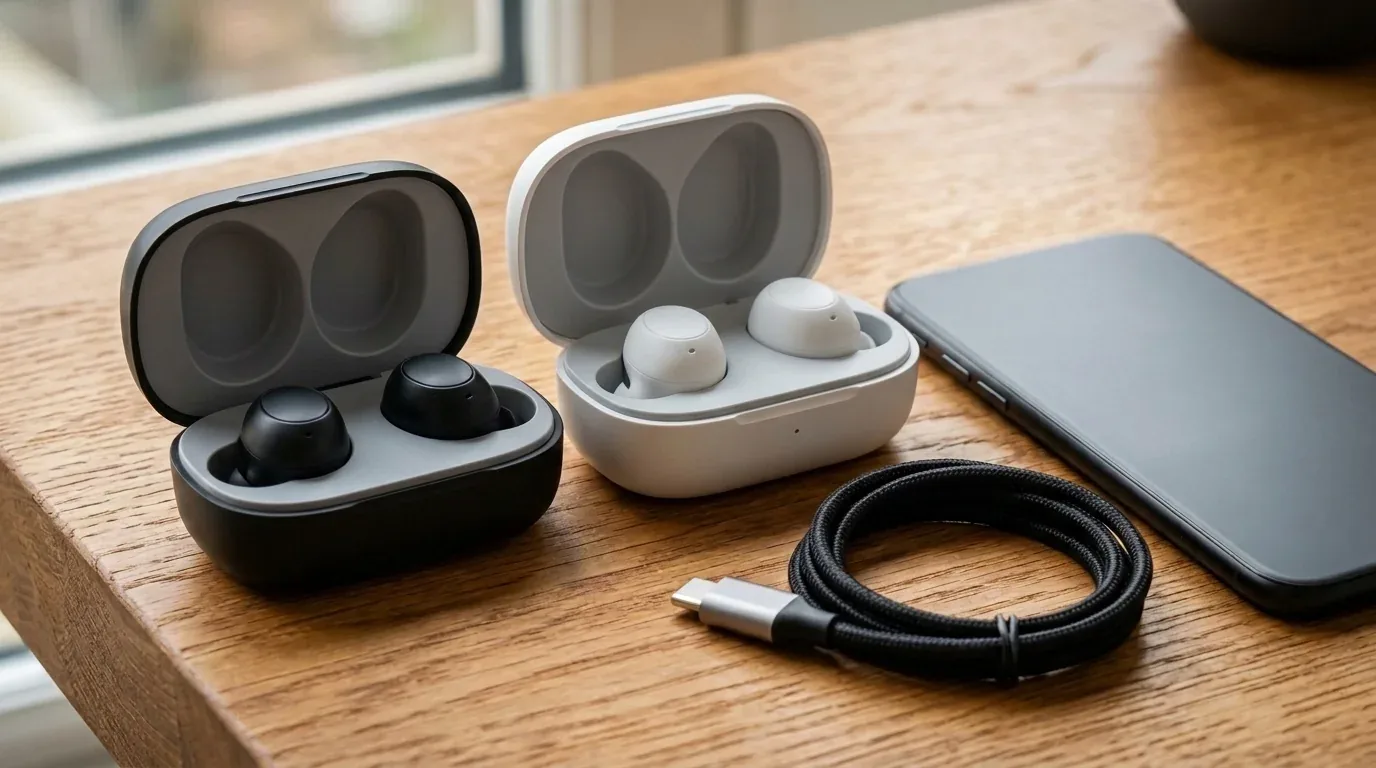
Having a charging case that recharges on a flat wireless pad on your desk or nightstand is wonderfully convenient. In the sub one hundred dollar bracket, wireless Qi charging is usually the first feature manufacturers cut to save factory costs. The Soundcore Space A40 and Soundcore Liberty 4 NC include wireless charging coils inside their cases, while the Sony WF-C510 and CMF Buds Pro 2 require a standard USB-C cable. If dropping your gear on a wireless desk pad matters to you, verify that the spec sheet explicitly mentions Qi charging before clicking buy.
The Truth About Battery Replacement and Repairability
Many shoppers ask whether they can pop open budget earbuds and replace the lithium battery when it wears out after two or three years. The honest answer is no. To achieve IPX4 and IPX5 sweat resistance ratings, factories weld the plastic shells together with acoustic glue. Attempting to pry open a budget earbud will crack the plastic housing and tear the delicate ribbon cables inside. When you buy wireless earbuds under one hundred dollars, treat them as sealed consumer products with a practical lifespan of two to three years of daily service.
Frequently Asked Questions About Budget Wireless Earbuds
What are the best budget earbuds in 2026?
The Anker Soundcore Space A40 is the best overall budget pair in 2026 for most buyers. It costs between fifty and sixty dollars, provides outstanding adaptive active noise cancellation that silences trains and buses, delivers eight hours of playtime on a single charge, and supports high resolution LDAC audio.
Which budget wireless earbuds are the best?
The right pair depends on your main daily activity. For daily public transit commuters, the Soundcore Space A40 wins for noise cancellation. For music enthusiasts who want the most detailed instrument separation, the EarFun Air Pro 4 Plus leads with dual drivers. For workout fans and kids, the twenty-five dollar JLab Go Air Pop is unbeatable for durability and simple charging.
Which are the best earbuds under 100 dollars?
The top five earbuds under one hundred dollars right now are the Anker Soundcore Space A40, EarFun Air Pro 4 Plus, CMF by Nothing Buds Pro 2, Sony WF-C510, and SoundPEATS Capsule3 Pro Plus. Each of these models delivers sound performance and build quality that rival earbuds costing twice as much.
What are the top 5 wireless earbuds?
In the affordable category under one hundred dollars, the top five ranked earbuds are the Soundcore Space A40 for all round value, EarFun Air Pro 4 Plus for audio engineering, CMF Buds Pro 2 for clever case controls, Sony WF-C510 for natural acoustic clarity, and JLab Go Air Pop for pure budget reliability.
Which budget earbuds have the best active noise cancellation?
The Anker Soundcore Liberty 4 NC and Soundcore Space A40 offer the strongest active noise cancellation under one hundred dollars. Both pairs use multi-mic feedback loops that cut out up to ninety percent of steady, low frequency rumble from airplane cabins, subway tracks, and air conditioning units.
Can you sleep on your side with budget wireless earbuds?
Yes, but you need to choose bean-shaped earbuds like the Soundcore Space A40 or Sony WF-C510 that sit flat inside your ear bowl. Stem-style earbuds lever painfully against your pillow. Make sure to turn off touch controls in your companion app before falling asleep so your pillow does not accidentally trigger loud volume spikes in the middle of the night.
Can you use only one earbud at a time?
Yes. All of the top picks on this list support independent mono playback. You can take either the left or right earbud out of the case on its own for phone calls or podcast listening while the other bud stays in the case charging.
Why is my left earbud quieter than my right earbud?
In almost every case, a quiet earbud is caused by earwax and moisture clogging the microscopic acoustic mesh screen beneath the silicone ear tip rather than a blown speaker. Gently brushing the dry mesh with a soft toothbrush and wiping it with a barely damp alcohol swab restores full audio volume immediately.
Can you replace the battery in budget wireless earbuds when it dies?
No. Budget wireless earbuds are permanently glued together to keep out water and sweat. Once the small internal battery wears out after two to three years of daily charging cycles, the earbud cannot be opened or repaired without breaking the plastic shell.
Which cheap wireless earbuds have low latency for gaming?
The EarFun Air Pro 4 Plus and SoundPEATS Capsule3 Pro Plus have dedicated Game Mode settings that you can turn on inside their smartphone apps. This cuts wireless transmission delay down to roughly fifty-five milliseconds, making gunshot effects and spoken dialogue line up cleanly on Nintendo Switch, Steam Deck, and mobile games.
How do you find lost budget wireless earbuds?
Modern budget models from Soundcore, EarFun, and CMF connect with Google Fast Pair to save the last known GPS map coordinates where your phone was connected to them. Their companion apps also include an acoustic paging feature that makes the lost earbud beep loudly from under a car seat or couch cushion.
Which earbuds under 100 dollars support wireless charging?
The Anker Soundcore Space A40 and Soundcore Liberty 4 NC both feature wireless Qi charging coils built into their pocket cases, letting you charge them on any flat desktop pad. Most other budget competitors, including the Sony WF-C510 and CMF Buds Pro 2, omit wireless coils and require a USB-C cable.
What are the best budget wireless earbuds with ear hooks?
If silicone tips tend to slip out of your ears during vigorous exercise, the Skullcandy Push Active and JLab Epic Air Sport are the best budget earbuds with wraparound ear hooks. The flexible ear hooks lock over the top of your ear, keeping the speakers in place through heavy running and gym workouts.
Which budget earbuds have the best microphone for phone calls?
The EarFun Air Pro 4 Plus and CMF by Nothing Buds Pro 2 provide the clearest voice recording on phone calls under one hundred dollars. Both models use beamforming microphones with digital speech enhancement to isolate your voice from street traffic and wind noise.
What are the best wireless earbuds under 100 on Reddit?
On Reddit communities like r/Earbuds and r/Headphones, the most frequently recommended budget pairs under one hundred dollars are the Soundcore Space A40, EarFun Air Pro 4, OnePlus Buds 3, and Moondrop Space Travel. Enthusiasts praise the Space A40 for its small pocket size and battery life, and the EarFun Air Pro 4 for its advanced Qualcomm codecs.
Are expensive earbuds really worth it compared to budget pairs?
Premium earbuds priced between two hundred and three hundred dollars still offer advantages in spatial head tracking, premium microphone arrays for noisy offices, and higher build materials. However, for everyday music streaming, podcasts, gym sessions, and daily commuting, today budget earbuds under one hundred dollars deliver roughly eighty-five to ninety percent of the premium experience at a fraction of the cost.
Final Verdict (Which Pair Should You Buy?)
You do not need to empty your savings account to enjoy wireless music and quiet commutes in 2026. Here is my simple advice on which pair to put in your cart today.
Buy the Soundcore Space A40 if you ride trains, buses, or planes and want proven active noise cancellation, fifty hours of total battery life, wireless Qi charging, and a discreet, low profile fit.
Buy the EarFun Air Pro 4 Plus if you are an Android user who loves high resolution sound, wants future proof Bluetooth tech with Auracast, plays games with low latency, and needs clear phone calls on city streets.
Buy the CMF by Nothing Buds Pro 2 if you want modern styling, heavy bass for pop and hip hop, and the convenience of a real physical control dial on your charging case.
Buy the Sony WF-C510 if you have smaller ears, prefer natural, balanced acoustic sound, want real physical click buttons, and need eleven hours of non-stop battery life without having to recharge.
Buy the JLab Go Air Pop if you want a reliable twenty-five dollar pair to keep in your gym locker or backpack with an integrated charging cable that never gets lost.
Loading comments…