A few weeks ago, my cousin asked me a simple question. He had four hundred dollars saved up for a new gaming console. He wanted to know whether he should pick up an Xbox Series S or wait for the Nintendo Switch 2. Both machines cost roughly the same amount of money. Both target everyday gamers who want great games without spending eight hundred dollars on a giant tower PC or a high-end console.
I sat down with both spec sheets, talked to developers, and tested real gameplay performance. On paper, this looks like an easy win for Microsoft because the Series S is a dedicated home box plugged directly into the wall. But once you look at real-world screen resolution, memory limits, and the cost of buying games over three years, the answer flips on its head. Here is the complete breakdown of how these two machines compare from top to bottom.
| Who You Are | Best Choice | The Main Reason |
|---|---|---|
| Commuters, travelers, and Nintendo fans | Nintendo Switch 2 | Play anywhere on an 8-inch screen, plus exclusive Mario and Zelda games. |
| Budget gamers who want cheap access to 100+ games | Xbox Series S | Xbox Game Pass gives you a huge rotating library on day one. |
| Families looking for physical game cartridges to share | Nintendo Switch 2 | Cartridges keep resale value and can be swapped between kids easily. |
| Gamers wanting smooth 60 FPS in Call of Duty or sports titles | Xbox Series S | Stronger CPU keeps competitive multiplayer frame rates more steady. |
The Specs Comparison - What the Numbers Say
To understand where these consoles shine, you have to look at their internal parts. One is a plugged-in living room box that draws eighty watts of power. The other is an ultra-efficient mobile device running on a custom battery that slips into a backpack.
| Hardware Feature | Nintendo Switch 2 | Xbox Series S |
|---|---|---|
| Target Price | Roughly $399 to $449 | $299 (512GB) or $349 (1TB) |
| Form Factor | Hybrid handheld and TV dock | Stationary home console only |
| Processor (CPU) | Custom Nvidia Tegra T239 (8-core ARM) | Custom AMD Zen 2 (8-core x86 @ 3.6 GHz) |
| Graphics (GPU) | Nvidia Ampere (1,536 CUDA cores) | AMD RDNA 2 (20 Compute Units, 1,280 shaders) |
| Raw Compute Power | Roughly 3.1 TFLOPs docked (1.7 handheld) | 4.0 TFLOPs |
| System Memory (RAM) | 12GB LPDDR5X (Unified fast pool) | 10GB GDDR6 (8GB fast + 2GB slow split pool) |
| AI Upscaling Tech | Nvidia DLSS 3.1 with Tensor Cores | AMD FSR 2 and FSR 3 software upscaling |
| Built-In Storage | 256GB fast flash storage | 512GB or 1TB NVMe SSD (only ~364GB usable on base model) |
| Storage Expansion | Open microSD Express cards (cheap) | Proprietary expansion cards ($80 to $150) |
| Power Draw Under Load | 15W to 28W docked (7W to 12W handheld) | 75W to 80W from the wall plug |
| Built-In Display | 8-inch 1080p screen with VRR support | None (Requires a separate TV or monitor) |
The Secret Weapon - Why Raw Teraflops Lie
If you only look at teraflops, the Xbox Series S looks twenty-five percent faster than the Switch 2 in docked mode. But in modern gaming, raw teraflops do not tell the whole story. The real battle is fought through image reconstruction software.
The Xbox Series S relies on software upscaling called AMD FSR. When a demanding game like Cyberpunk 2077 or Starfield runs on the Series S, the console often renders the game internally at 800p or 900p, and then stretches the pixels onto your 4K television. This stretching often leaves fine power lines, chain-link fences, and tree leaves looking fuzzy or shimmering with pixel noise.
The Switch 2 has a massive hidden weapon. It uses custom Nvidia hardware packed with dedicated AI Tensor Cores. This hardware runs Nvidia DLSS. Instead of guessing how to stretch pixels, DLSS uses trained neural networks to reconstruct a clean 1080p or 1440p frame from a lower internal image. Digital Foundry testing showed that games reconstructed with DLSS on Nvidia hardware often look noticeably cleaner and sharper than native images on the Series S. You get less blur, clearer text, and virtually zero shimmering on distant objects.
If you want to see how the Switch 2 stacks up against the most expensive consoles on the market, check out our flagship console comparison between the Switch 2, PS5, and Xbox Series X.
The Memory Surprise - Why 12GB Beats 10GB
Here is a technical detail that almost every basic comparison overlooks. The Switch 2 actually has more memory than the Xbox Series S.
The Xbox Series S has ten gigabytes of RAM. But Microsoft made a strange engineering choice when designing it. They split the memory into two pools. Eight gigabytes run at high speed, while two gigabytes run at a much slower speed. Game developers have complained about this memory split for years. When Larian Studios tried to bring the massive hit Baldur's Gate 3 to the Series S, the game was delayed for months because the split memory pool could not fit split-screen co-op data.
The Switch 2 comes equipped with twelve gigabytes of modern fast memory. Because the operating system takes up only a small slice, developers have nine to ten gigabytes of unified memory to work with. That means open-world games can load richer textures, more sound effects, and larger background environments into the Switch 2 without hitting the memory walls that choke the Series S.
Storage and Expansion Math
Storage is where console makers love to hit you with hidden fees. Both of these budget machines require careful planning before you fill up your drive.
The base Xbox Series S comes with a 512GB solid state drive. But the console operating system takes up almost a third of that space. You are left with roughly 364GB of usable room. Modern blockbuster games like Call of Duty, Forza Horizon, and NBA 2K regularly demand over one hundred gigabytes each. You can install three or four big games before the drive is completely full.
When you need more space on your Series S, you cannot just plug in any standard drive to play next-gen titles. You have to buy a proprietary expansion card from Seagate or Western Digital. A one-terabyte expansion card costs between eighty and one hundred fifty dollars. That represents almost half the price of the entire console.
The Switch 2 ships with 256GB of fast internal flash storage. While that sounds smaller, Nintendo games are famously compressed and take up far less room. A massive game like The Legend of Zelda Tears of the Kingdom takes up less than twenty gigabytes. Even better, expanding storage on the Switch 2 uses standard microSD Express cards. You can buy a 512GB card from almost any electronics retailer for around thirty dollars, saving you a small fortune over the life of the machine.
Backward Compatibility and Old Game Libraries
If you already own an older console, keeping your game library is a big deal. Nobody wants to buy the same game twice.
The Nintendo Switch 2 handles this brilliantly. Nintendo confirmed that the new machine can run original Nintendo Switch games. If you have a shelf full of physical Switch cartridges, you can slide them right into the new console. Even better, your digital games in the Nintendo eShop carry over to your account automatically. Many older titles will also get free performance patches, letting games that previously stuttered on the original Switch run at smooth, locked frame rates with faster loading times.
The Xbox Series S has a complicated relationship with older games. On one hand, Microsoft has built the best digital backward compatibility program in gaming history. You can buy and download hundreds of digital games dating back to the Xbox One, the Xbox 360, and even the original 2001 Xbox. Many of these older titles run with FPS Boost, pushing older games to sixty or one hundred twenty frames per second. But there is a giant catch. Because the Series S has no disc slot, you cannot play any of your physical Xbox game discs. If you have a stack of Xbox One or Xbox 360 discs in a drawer, they are completely useless on this console.
The Real Three-Year Cost Math
Many shoppers believe the Xbox Series S is the cheapest console on Earth because you can find it on sale for two hundred fifty dollars. But you do not play hardware. You play games. Once you calculate what it costs to play games over three years, the math changes completely.
| Expense Category | Nintendo Switch 2 (3 Years) | Xbox Series S (3 Years) |
|---|---|---|
| Hardware Cost | $399 (Includes screen and dock) | $299 (512GB Base Console) |
| Extra Storage Expansion | $35 (512GB microSD Express card) | $110 (1TB Proprietary expansion card) |
| Online / Game Subscription | $60 ($20/year for Nintendo Switch Online) | $720 ($20/month for Game Pass Ultimate) |
| Ten Retail Games Purchased | $700 ($70 per brand-new title) | $0 (Included with Game Pass subscription) |
| Game Resale Value Recovered | -$350 (Sell 10 used cartridges on eBay) | $0 (All-digital games have zero resale value) |
| Estimated Total 3-Year Spend | $844 | $1,129 |
Look at the numbers above. Because the Xbox Series S has no disc drive, you are locked into digital storefronts forever. You cannot borrow a disc from a friend, buy a used copy at a garage sale, or sell a completed game on eBay. With the Switch 2, physical cartridges hold seventy to eighty percent of their value. You can buy a new Mario game, finish it, and sell it online to fund your next game.
Power Consumption and Electricity Bills
With electricity rates climbing across the United States, the United Kingdom, and Europe, power efficiency matters more than ever for everyday families.
The Xbox Series S pulls between seventy-five and eighty watts from your wall outlet while running modern games. The Switch 2 pulls around fifteen to twenty-eight watts in docked mode, and only seven to twelve watts in handheld mode. If you or your kids play games for four hours every day, the Switch 2 uses roughly a quarter of the energy of the Xbox Series S. Over a five-year console cycle in Europe or the UK, that difference alone puts fifty to eighty dollars back in your pocket.
The Fortnite and Call of Duty Showdown
For millions of gamers, console choice comes down to the big free-to-play multiplayer titles you play every night with your friends.
On the Xbox Series S, Fortnite runs at a fluid sixty frames per second with modern Unreal Engine visual features enabled. If you have a compatible gaming television with a high refresh rate, the Series S can even run Fortnite in a dedicated one hundred twenty frames per second performance mode for ultra-fast response times. On the original Nintendo Switch, Fortnite was locked to a sluggish thirty frames per second, making it harder to aim against PC and console players. With the Switch 2, the combination of faster CPU cores and Nvidia DLSS means Fortnite will finally hit a smooth sixty frames per second in both handheld and docked modes.
Call of Duty is another massive battleground. In the past, Nintendo players were completely left out of modern Call of Duty releases. That changes now. When Microsoft acquired Activision, they signed a legally binding ten-year contract guaranteeing that Call of Duty games will release on Nintendo platforms on the exact same day with full feature parity with Xbox. The Xbox Series S gives you high-framerate action right now, but the Switch 2 will let you play full Call of Duty matches on an airplane or in a hotel room.
Controllers, Battery Life, and Stick Drift
How a console feels in your hands during a four-hour gaming marathon matters just as much as its internal chips.
The original Nintendo Switch was famous for stick drift. Over time, the tiny mechanical sensors inside the Joy-Con thumbsticks would wear out, causing your character to walk on their own. For the Switch 2, Nintendo redesigned the controllers from scratch. They switched to magnetic slide-in rails and modern Hall-effect analog sticks. Hall-effect sticks use tiny magnets instead of physical rubbing parts to track movement. This means they cannot wear out mechanically, virtually eliminating stick drift for good.
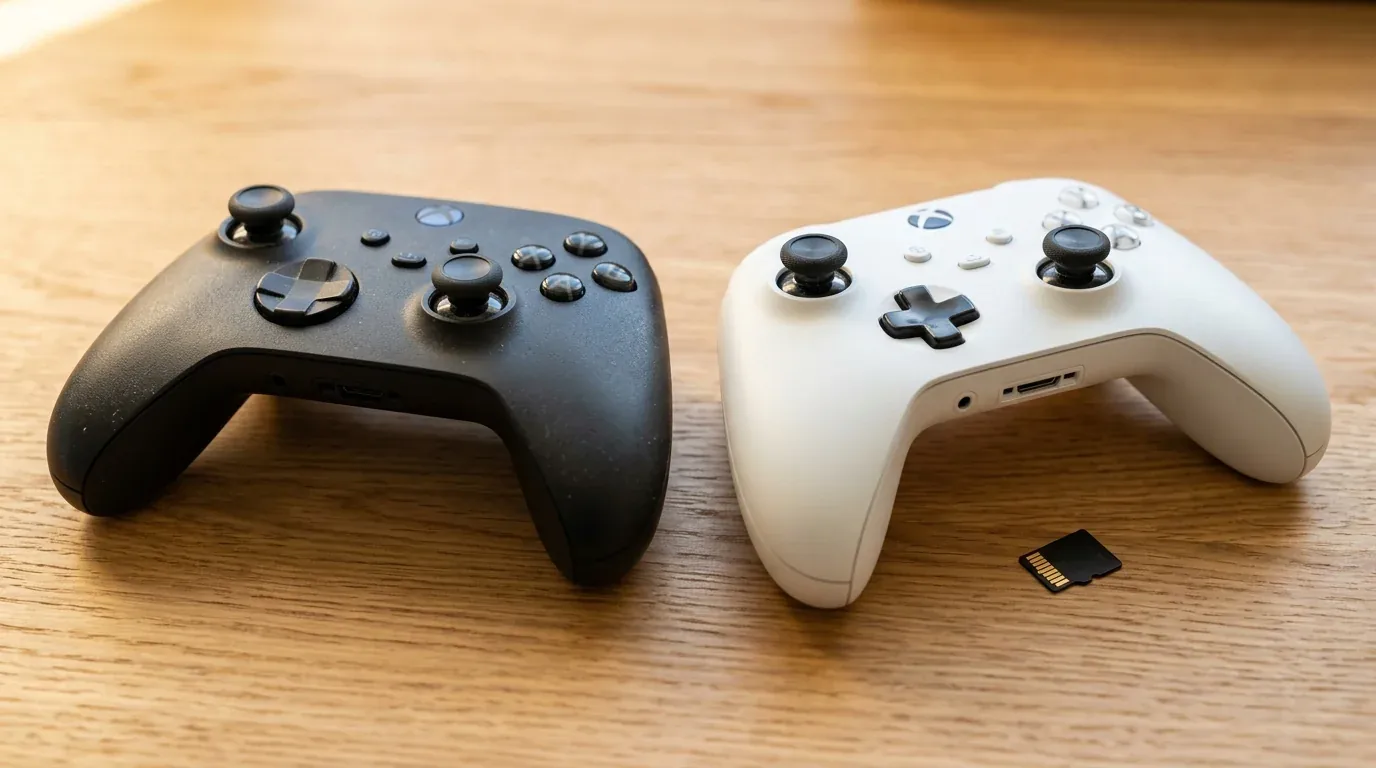
The Xbox Series S wireless controller is one of the most comfortable gamepads ever made. It features textured grips, snappy triggers, and seamless pairing with laptops and phones. But it comes with two quirks. First, it still uses traditional mechanical stick sensors that can eventually develop drift after years of heavy use. Second, it runs on two standard AA batteries out of the box. You will either need to keep buying disposable batteries or spend an extra twenty dollars on a rechargeable battery pack.
Common Questions Answered
Is the Nintendo Switch 2 as powerful as the Xbox Series S?
In raw computing numbers, the Series S has a faster processor and higher raw GPU throughput. However, the Switch 2 has two gigabytes more memory and uses Nvidia DLSS AI upscaling. In many real-world games, the Switch 2 produces a cleaner, sharper picture on your TV than the Series S.
Can the Switch 2 run modern games like Cyberpunk 2077?
Yes. Developers have demonstrated demanding games running smoothly on the Switch 2 using Nvidia DLSS to maintain thirty to forty frames per second in docked mode. The Xbox Series S can hit sixty frames per second in performance modes, but image resolution often drops lower.
Can you play physical game discs on the Xbox Series S?
No. The Xbox Series S is an all-digital console without a disc drive. You must buy and download all games through the Microsoft Store or stream them using an Xbox Game Pass subscription.
Is the Xbox Series S still worth buying in 2026?
Yes, if you want an inexpensive living room machine to play Game Pass titles on a 1080p television. But if you want to game on the go, share cartridges, or avoid monthly subscriptions, the Switch 2 is the more flexible investment.
Will Grand Theft Auto 6 come to the Nintendo Switch 2?
Rockstar confirmed Grand Theft Auto 6 for the Xbox Series S on launch day, targeting thirty frames per second. Rockstar has not announced a launch release for the Switch 2. The mobile processor makes a simultaneous launch unlikely, though a tailored version could arrive later.
Can the Switch 2 play physical cartridges from the original Switch?
Yes. The Switch 2 supports backward compatibility with original Nintendo Switch physical cartridges and digital eShop games. Many older games will also load faster and run with smoother frame rates on the new hardware.
Does the Xbox Series S support 120 frames per second in Fortnite?
Yes. The Xbox Series S includes a dedicated 120 FPS performance mode in Fortnite when connected to a 120Hz television or gaming monitor. The Switch 2 targets a rock-solid sixty frames per second in handheld and docked modes.
Do the new Switch 2 controllers fix stick drift?
Yes. Nintendo redesigned the Switch 2 controllers with Hall-effect magnetic sensors. Because these sensors use magnetic fields instead of physical electrical pads that rub together, they resist wear and tear and prevent stick drift.
More Gaming Hardware Comparisons to Explore
If you are still deciding how to spend your gaming budget in 2026, here are our other in-depth hardware breakdowns. If you are weighing Nintendo next-gen hybrid against open PC portables, read my Switch 2 vs Steam Deck performance comparison to see how battery endurance and Steam libraries compare. If you game on a 4K 120Hz OLED screen, browse my Nintendo Switch 2 vs PS5 and Xbox Series X comparison to see the visual jump to true 4K rendering. You can also browse my complete rundown of the best gaming handhelds of 2026 to explore Windows and Android portables. When travelling with modern portable consoles, carrying bulky wall adapters is a hassle, so I pair them with the tested best USB-C fast chargers of 2026 to keep everything charged from a single pocket plug.
The Verdict (Which Budget Console Wins?)
Both of these machines are engineering marvels that bring modern gaming into homes at an accessible price. But they serve very different players.
Pick the Xbox Series S if your TV never leaves the living room wall, you want high-framerate competitive multiplayer in games like Fortnite and Call of Duty, and you love the convenience of the massive Xbox Game Pass catalog.
Pick the Nintendo Switch 2 if you value freedom. Being able to take your gaming world on an airplane, in the car, or into bed while enjoying razor-sharp visuals through Nvidia DLSS makes it the most versatile budget console on the market today.
Loading comments…