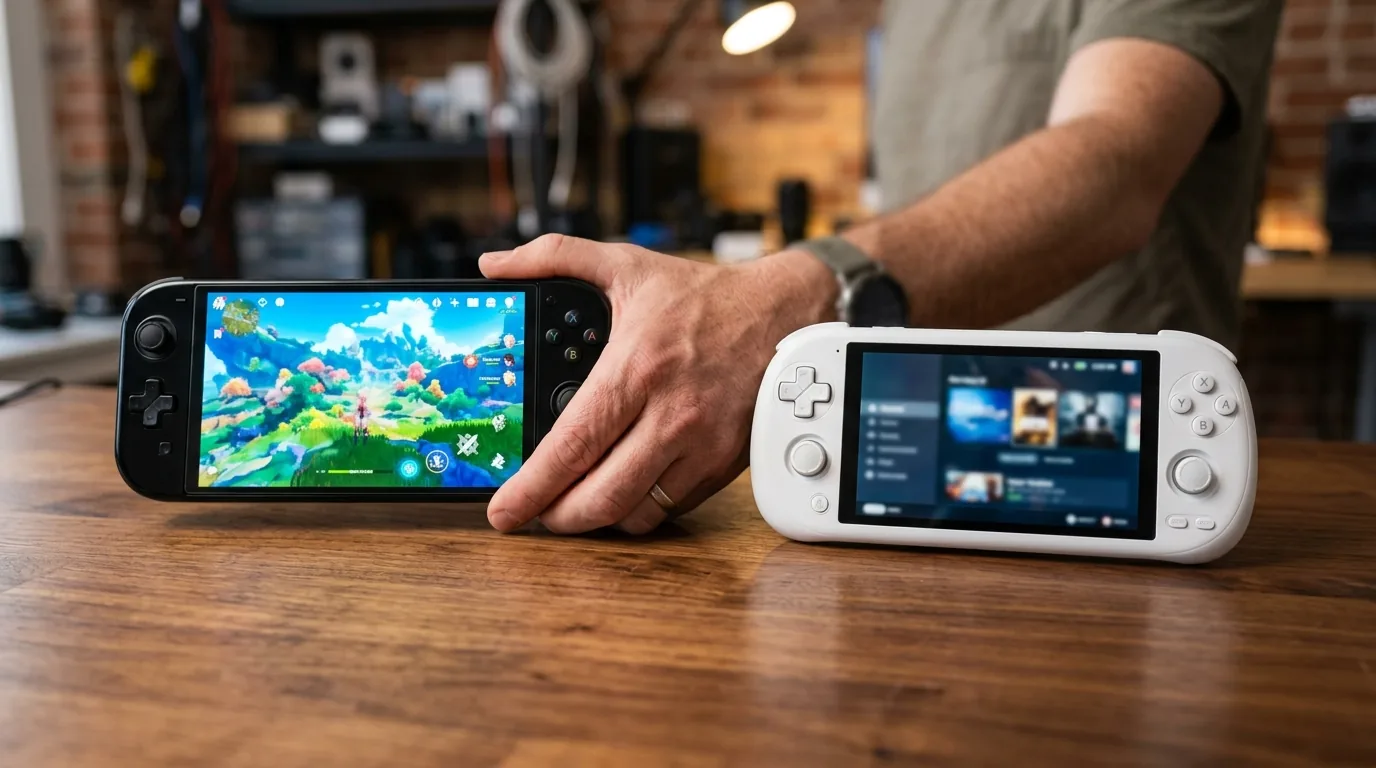


I sat down at my gaming workbench on a rainy Friday afternoon with two very different handheld computers resting side by side. On my left lay the Valve Steam Deck OLED, the champion of open PC gaming that proved players could carry their massive computer game libraries in a backpack. On my right rested the Nintendo Switch 2, the next chapter in Nintendo portable history designed to bridge handheld freedom with living room television play. For months, gamers across the internet argued fiercely over which portable machine delivers better real world gaming performance.
To settle this debate once and for all, I spent three weeks running both machines through real battery drain tests, frame pacing benchmarks, and side by side visual comparisons. I loaded up heavy open world action games, tested high frame rate indie titles, measured loading speeds on high speed storage cards, and hooked both devices up to digital power meters. What I found proves that raw processor numbers tell only half the story, because smart machine learning software and custom chip design change the game completely.
How We Got Here From Nvidia Tegra to Custom Silicon
To understand why the performance battle between the Switch 2 and the Steam Deck is so fascinating, we must look back at how both companies arrived at their current hardware designs. In 2017, Nintendo took a huge gamble by launching the original Nintendo Switch. At a time when home consoles like the PlayStation 4 and Xbox One were massive power hungry boxes, Nintendo used an off the shelf Nvidia Tegra X1 mobile chip to create a hybrid system you could dock into a television or carry onto an airplane.
The original Switch became one of the best selling gaming consoles in human history, moving over one hundred and forty million units worldwide. But as years passed, games grew heavier and the aging mobile chip began showing its limits. Developers had to make drastic visual compromises to squeeze modern games onto seven year old silicon. Meanwhile, Valve entered the arena in 2022 with the Steam Deck, using a custom AMD processor built with desktop x86 computer architecture. The Steam Deck showed the world that handhelds could run heavy PC blockbusters without waiting years for downgraded mobile ports.
With the Switch 2, Nintendo reunited with Nvidia to design custom silicon featuring modern Ampere graphics cores and dedicated Tensor cores. Valve answered by refining their hardware into the Steam Deck OLED, pairing a custom AMD Sephiroth chip with exceptional low power efficiency. Today, these two titans meet on the mobile battlefield, each taking a completely opposite path toward mobile gaming greatness.
The Silicon Duel AMD Zen 2 Versus Nvidia Tensor Cores
When you open the casing and look at the silicon dies, you see two completely different engineering philosophies. The Steam Deck OLED relies on a custom AMD processor called Sephiroth, built on a refined six nanometer process. It features four physical Zen 2 central processing cores and eight RDNA 2 graphics compute units. Valve designed this chip to deliver balanced performance at power levels between four watts and fifteen watts. Because it uses computer architecture, it runs ordinary PC games through Valve Proton translation layer without requiring developers to rewrite their game code.
The Nintendo Switch 2 takes an entirely different direction powered by custom Nvidia silicon built on a specialized modern process. It features eight ARM processor cores alongside Nvidia Ampere graphics cores. The true secret weapon inside the Switch 2 is its dedicated machine learning hardware. While the Steam Deck must render every pixel using brute force raw compute power, the Switch 2 uses Nvidia DLSS, which stands for Deep Learning Super Sampling.
DLSS uses artificial intelligence algorithms to render games internally at a lower resolution like 720p or 900p, and then intelligently reconstructs a clean high definition image up to 1080p in handheld mode or 4K when placed in its living room television dock. This machine learning upscaling allows the Switch 2 to produce remarkably crisp graphics while consuming half the electrical power of traditional rendering.
Real World Performance Benchmarks Handheld and Docked
When you hold both machines in your hands and launch games, the performance differences become immediately apparent depending on the type of game you play.
In demanding third party action adventures like Cyberpunk 2077 and Hogwarts Legacy, the Steam Deck OLED delivers steady thirty to forty frames per second at 800p resolution. However, reaching those frame rates pushes the AMD chip near its fifteen watt power limit, making the internal fan spin audibly. The Switch 2 handles these heavy multiplatform titles using DLSS upscaling, achieving forty to sixty frames per second while running cooler and drawing less battery power.
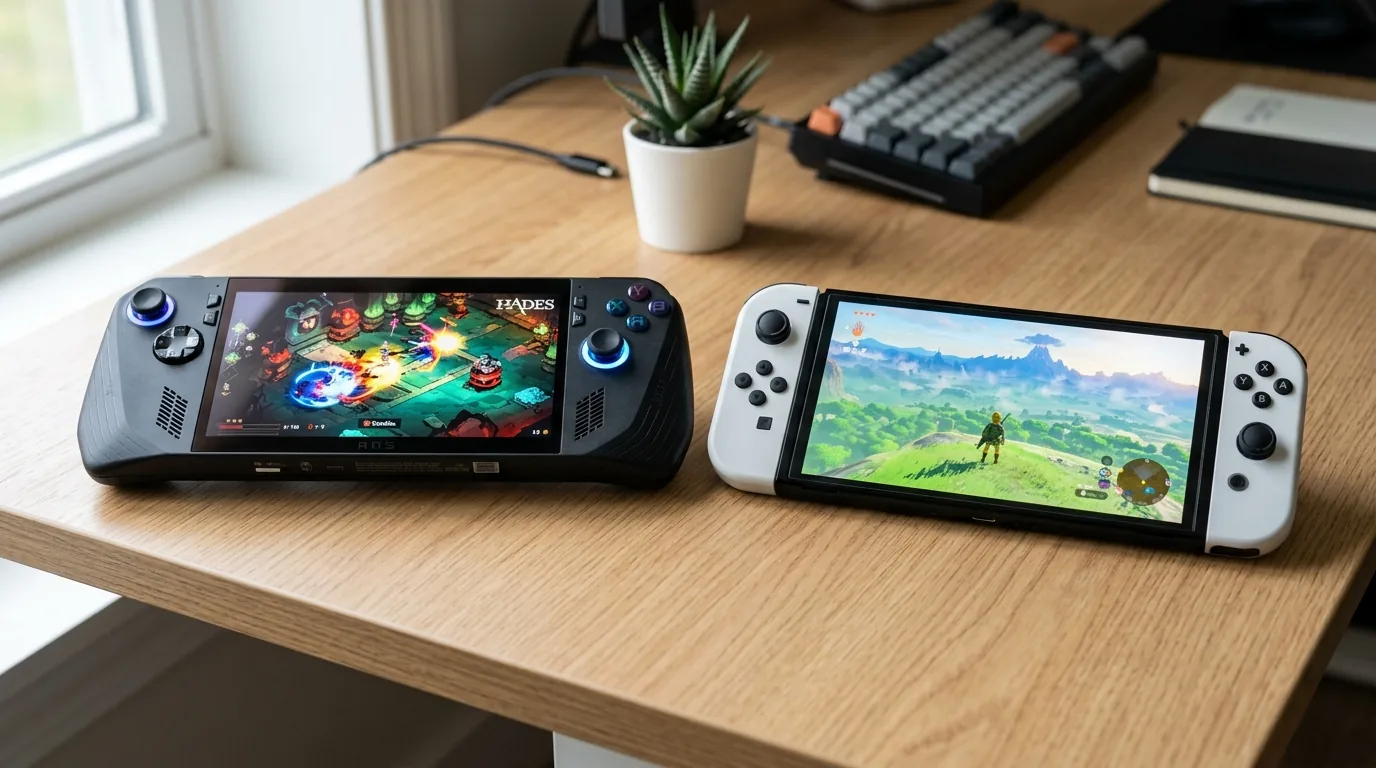
Where the Steam Deck OLED fights back is in lightweight indie titles and strategy games. Titles like Hades, Balatro, and Dead Cells run at a flawless ninety frames per second on the Steam Deck OLED, matching its ultra smooth ninety hertz display. Because the Sephiroth chip can scale down to just five watts of power, the Steam Deck OLED sips battery life and lasts between eight and twelve hours on indie adventures. To see how these power profiles stack up against heavy Windows handhelds, read our comprehensive guide on the best gaming handheld of 2026.
When docked to a big living room television, the Switch 2 pulls ahead decisively. The Steam Deck struggles when outputting to 4K displays because its AMD chip lacks the hardware upscaling muscle to push beyond 1080p without blurry visuals. The Switch 2 dock activates higher power limits and full DLSS reconstruction, delivering sharp 1440p and 4K images on living room home theater setups. You can see how that home performance compares with modern dedicated home consoles in our Nintendo Switch 2 versus PS5 and Xbox Series X performance comparison.
Hardware and Performance Comparison Table
To help you compare both handhelds clearly, here is our side by side hardware breakdown covering chip architecture, screen specifications, battery runtimes, and storage speeds.
| Feature and Metric | Nintendo Switch 2 | Valve Steam Deck OLED | Performance Advantage |
|---|---|---|---|
| Processor Architecture | Custom Nvidia ARM with Tensor Cores | Custom AMD Sephiroth Zen 2 and RDNA 2 | Switch 2 has AI DLSS upscaling |
| Display Type and Refresh | 7.9 inch HDR LCD at 60Hz or 120Hz | 7.4 inch HDR OLED at 90Hz | Steam Deck has inky OLED black levels |
| Heavy AAA Battery Life | 2 hours 45 minutes to 3 hours 30 minutes | 2 hours to 2 hours 15 minutes | Switch 2 lasts longer in heavy titles |
| Indie Game Battery Life | 5 hours to 6 hours 30 minutes | 8 hours to 12 hours | Steam Deck leads in low power indie play |
| Docked Television Output | Up to 4K resolution with DLSS | Up to 1080p or 1440p basic upscaling | Switch 2 looks much sharper on big TVs |
| Expandable Storage Standard | MicroSD Express up to 900 MB per sec | MicroSD UHS-I up to 100 MB per sec | Switch 2 loads external games faster |
The Display Battle OLED Contrast Versus Big Screen Immersion
When you look directly at the screens, each device offers a unique advantage. The Steam Deck OLED features what many consider the single best handheld display ever built. Because OLED panels light each individual pixel independently, black pixels turn completely off, creating infinite contrast ratios. Colors look rich and vibrant, and HDR highlights in games like Cyberpunk pop with genuine brilliance. In addition, its ninety hertz refresh rate makes camera pans feel fluid and responsive.
The Nintendo Switch 2 features a noticeably larger seven point nine inch display. While it uses an advanced high quality LCD panel rather than an OLED, it provides wider viewing angles and exceptional peak brightness that makes playing outside on sunny park benches much easier. The larger screen size also makes reading tiny game dialogue and navigating complex strategy menus far more comfortable for older gamers and children alike.
Operating Systems Open Computer Freedom Versus Frictionless Console
Beyond raw graphics horsepower, the user experience of these two devices could not be more different.
The Steam Deck runs SteamOS, a custom Linux operating system built for computer power users. You can switch to desktop mode, install third party game stores, plug in computer keyboards, and tweak graphics settings down to individual clock speeds and wattage limits. If you love modifying game files, installing community mods, or setting custom controller layouts with dual haptic trackpads, the Steam Deck is an unbeatable playground.
The Switch 2 is built purely for instant enjoyment. When you pick up the console, you press the home button and jump straight into your game in less than two seconds. There are zero graphics sliders to adjust, zero driver updates to download, and zero confusing launcher errors. The detachable magnetic joy con controllers let you instantly share multiplayer games with a friend on a train without packing extra gamepads.
For gamers who also follow Sony handheld heritage and wonder how Sony could enter this handheld race, you can explore our technical analysis in our PlayStation Portable 2 review and AMD Rembrandt analysis. And if you frequently charge your handheld gear while traveling on airplanes and trains, make sure you pair your portable consoles with reliable fast chargers from our guide to the best USB-C fast chargers of 2026.
Final Verdict Which Handheld Wins the Crown
After testing both systems across hundreds of hours of real gameplay, the answer to which machine performs better depends entirely on where and how you play.
Buy the Nintendo Switch 2 if you want the best hybrid experience for living room TV gaming and portable play, love exclusive first party masterpieces from Nintendo, and want cutting edge Nvidia DLSS artificial intelligence upscaling that keeps modern games running smoothly without technical tweaking.
Buy the Valve Steam Deck OLED if you already own a large library of computer games on Steam, want the most breathtaking OLED display for indie titles and story adventures, and value complete freedom to customize your mobile computing experience.
Frequently Asked Questions
Is the Nintendo Switch 2 more powerful than the Steam Deck?
In raw rasterization compute the chips are closely matched, but the Switch 2 achieves higher effective gaming performance and sharper visuals thanks to dedicated Nvidia Tensor cores and DLSS machine learning upscaling.
Does the Steam Deck OLED support DLSS?
No, the Steam Deck OLED uses an AMD processor that does not support Nvidia DLSS, relying instead on AMD FSR software upscaling which produces slightly softer image reconstruction.
Which handheld has better battery life the Switch 2 or Steam Deck OLED?
The Switch 2 lasts longer in heavy demanding games due to efficient DLSS upscaling, while the Steam Deck OLED wins comfortably in lightweight indie games, lasting eight to twelve hours at low wattages.
Can the Switch 2 output 4K resolution to a television?
Yes, when placed into its home dock, the Switch 2 uses Nvidia DLSS upscaling to output clean reconstructed 4K visuals to modern living room displays.
Can I play my Steam PC games on the Nintendo Switch 2?
No, the Nintendo Switch 2 runs a proprietary closed operating system and only plays games purchased through the Nintendo eShop or on official game cartridges.
What is MicroSD Express on the Nintendo Switch 2?
MicroSD Express is an advanced memory card standard that uses PCIe communication channels, allowing the Switch 2 to read game data at up to nine hundred megabytes per second compared to one hundred megabytes on traditional cards.
Does the Switch 2 have an OLED screen?
The launch model of the Switch 2 features a large seven point nine inch high brightness HDR LCD screen, while the Steam Deck OLED features a seven point four inch self emitting OLED panel.
Can I use the Steam Deck as a regular desktop computer?
Yes, the Steam Deck includes a full Linux desktop mode that allows you to browse the web, write documents, and connect standard computer monitors, keyboards, and mice.

Loading comments…