

For most of the last decade, humanoid robots were a press-release business. The hardware existed, the demo videos circulated, the funding rounds closed, and the public mostly saw what the vendors chose to publish. In 2026, that has changed. The first paid commercial-scale humanoid deployment is now running at BMW Group's Spartanburg[1] plant in South Carolina, with an initial fleet of 40 Figure 03 units working the body shop at roughly $25 per robot-operating-hour. The same generation of robot is also open for $20,000 home pre-order[8] from 1X, the Unitree G1 is in stock at $13,500[3] from Hangzhou, and AgiBot has become the first manufacturer to ship more than 10,000 units of any humanoid in a single year.
Eight platforms now sit in serious procurement discussion. Six of them can be ordered, reserved, or contracted in 2026. Two of them — Tesla Optimus and the retired hydraulic Atlas — cannot. The article below normalises the published specs across all eight, separates what each vendor is selling from what it has merely demonstrated, and answers the question a factory manager, a research lead, or a portfolio analyst will actually ask: what can I get, what does it cost, and what is the engineering reality behind the headline number?
The Four Quadrants of the 2026 Humanoid Market
Every humanoid platform discussed in 2026 sits in exactly one of four states. The quadrant determines what a buyer can actually do with the platform in 2026.
| Quadrant | What it means | Platforms in 2026 |
|---|---|---|
| Shipping now | Order today, take delivery in days or weeks. | Unitree G1 (basic + EDU); Unitree H2 (China-direct, fluctuating stock); AgiBot A2 (China + EU + US tri-certified) |
| Reservable | Refundable deposit secures a build slot for a future delivery date. | 1X NEO ($20,000 or $499/month, US deliveries Q3 2026); NEURA 4NE-1 Gen 3.5 (€98,000, late 2026); NEURA 4NE-1 Mini (€19,999, April 2026) |
| Pilot contract only | Engaged through a quote-based B2B agreement, no public order page. | Apptronik Apollo 2 (Mercedes-Benz, GXO, Jabil); Figure 03 enterprise (BMW Spartanburg, paid $25/operating-hour) |
| Demonstration only | Shown publicly by the vendor but not sold or contracted to external parties in 2026. | Tesla Optimus (internal Tesla factories only); Boston Dynamics Atlas (Hyundai + Google DeepMind pilot commitments, not commercially available to outside buyers) |
The "reservable" and "pilot contract only" categories are the most misunderstood. A $20,000 reservation with 1X or a €98,000 quote from NEURA does not deliver a robot in 2026; it secures the right to receive one. The Figure 03 commercial fleet at BMW is not a sale — Figure bills BMW for each hour the robots operate, and Figure retains the hardware.
The 2026 Humanoid Robot Spec Sheet
The table below normalises every published or vendor-stated specification across the eight platforms. Sources, dates checked, and verification status are recorded in the source ledger accompanying this article. "Not published" is used wherever a vendor has not disclosed a number; "unverified" is used wherever a third-party tracker has reported a figure the vendor has not confirmed.
| Platform | Origin | Height / weight | Total DOF (body + hands) | Payload (peak / continuous mobile) | Battery runtime | Compute | SDK | IP rating | 2026 list price | Status |
|---|---|---|---|---|---|---|---|---|---|---|
| Unitree G1 (basic) | Hangzhou, CN | 132 cm / 35 kg | 23 (no hands) up to 43 (Dex5-1P) | 2 kg/arm (basic) / 3 kg (EDU) | ~2 h active (9 Ah) | 8-core ARM; EDU: NVIDIA Orin | Closed for basic; open via Unitree GitHub for EDU | Not published | $13,500 | Shipping now (China + international resellers) |
| Unitree H2 | Hangzhou, CN | 180 cm / 70 kg | 31 body | 15 kg peak / 7 kg rated | ~3 h (15 Ah, quick-release) | Intel Core i5 base; i7 EDU; 2,070 TOPS Jetson Thor option | Closed base; EDU: secondary development supported | Not published | $29,900 China list; $40,900 NA partner (Toborlife); $68,900 EDU; $100,000 H2 Plus | Pre-orders open via North American partner; China store currently contact-sales |
| Apptronik Apollo 2 | Austin, TX, US | 173 cm / 73 kg | Not published (44+ reported) | 25 kg rated | 4 h per hot-swap pack (up to 22 h/day) | NVIDIA Jetson AGX Orin + Orin NX (275+ TOPS) | Closed Artemis stack; Google DeepMind Gemini Robotics 2.0[7] partner | Not published | Not published; <$50,000 at-scale target (2023 Cardenas) | Pilot contract only (Mercedes-Benz, GXO, Jabil) |
| Figure 03 | Sunnyvale, CA, US | ~168 cm / ~61 kg | 40+ (16-DOF hands) | 20 kg | ~5 h (wireless 2 kW charging) | Figure Helix 02 VLA (3× Figure 01 compute) | Closed | Not published | ~$25/operating-hour at BMW; ~$20,000 long-run consumer target | Enterprise RaaS only |
| Tesla Optimus (Gen 2 / V3) | Austin, TX, US | 173 cm / 57 kg | 28 body (Gen 2); 37 joints (V3) + 22 DOF[14] per hand | 20 kg rated; ~68 kg deadlift target (unconfirmed) | 6–8 h (2.3 kWh, 52V) | Tesla AI5 (~5× AI4, taped out April 2026) | Closed (Tesla-internal) | Not published | USD 20K–USD 30K target per Musk, October 2024; not on sale | Demonstration only (internal Tesla factories) |
| NEURA 4NE-1 Gen 3.5 | Metzingen, DE | 180 cm / 80 kg | 25+ (NEURA) / 55 (12 per hand, third-party tracker) | 100 kg peak (leg-supported) / 20 kg arm / 15–20 kg continuous | 6–8 h (dual hot-swap) | NVIDIA Thor T5000 (water-cooled) | Python / ROS 2 / C++ SDK | Not published | €98,000 (1–19 units) / €60,000 (20+ units) | Reservable; ships late 2026 |
| Boston Dynamics Atlas (electric) | Waltham, MA, US | 1.9 m / 90 kg | 56 (fully rotational joints) | 50 kg instant / 30 kg sustained / 20 kg one-handed | 4 h (2 h heavy lifting); 3-min autonomous swap | Not published | Closed; Orbit fleet software | IP67, -20°C to 40°C | Not published; industry estimate $150K–$420K | Pilot commitments (Hyundai, Google DeepMind) only |
| 1X NEO | Sunnyvale, CA / Moss, NO | 165 cm / ~30 kg | Not published | Not published (home humanoid) | Not published | Not published | Not published | Not published | USD 20,000 (Early Access) or USD 499/month | Reservable; first US deliveries Q3 2026 |
Two smaller commercial players round out the field. AgiBot A2 is the only humanoid with tri-region safety certification (China, US, EU; May 2025), 40–49+ DOF, 200 TOPS AI compute, the same on-device inference trade-off Google makes with the Tensor G5 at phone scale, 7 km/h walking, and a published shipment count above 10,000 units. The wheeled AgiBot G2 (Genie) pairs dual NVIDIA Jetson Thor T5000[19] modules for 2,070 TFLOPS of on-board compute. Booster Robotics, XPeng, and Fourier Intelligence each ship limited research or industrial units but have not published 2026 list prices that match the eight above.
Eight Platforms in Their Own Words
Unitree G1 — the cheapest credible humanoid, but basic model is demo-only
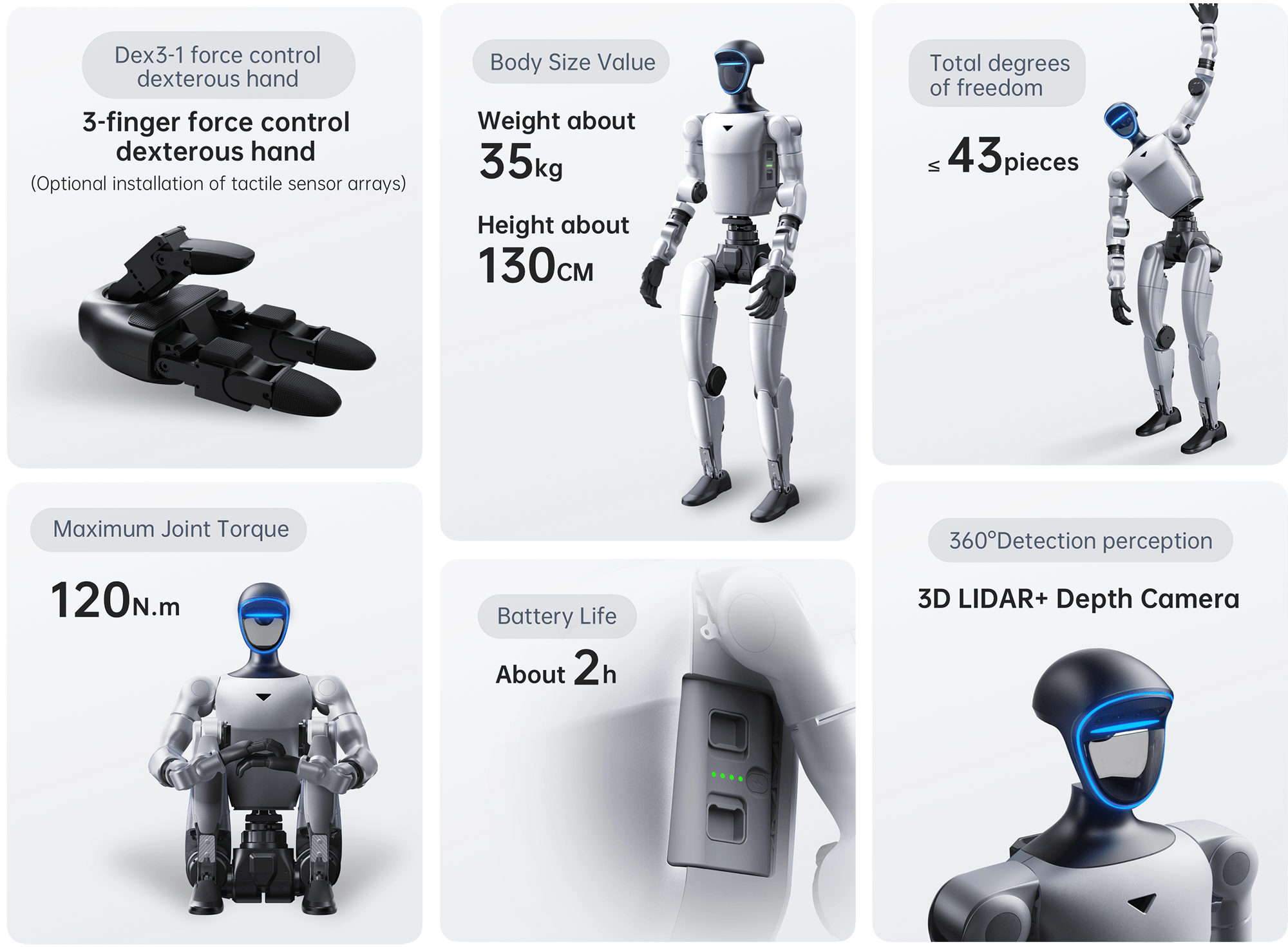
Unitree's G1 spec sheet lists the basic configuration at $13,500: 132 cm, 35 kg, 23 DOF, 9,000 mAh battery good for about two hours of active use, a depth camera plus Livox MID-360 3D LiDAR, and an 8-core ARM compute module. The basic G1 is a research and education platform that explicitly does not support secondary development and ships with an eight-month warranty. To get a usable development kit you need the EDU tier, which lists at quote-only and goes up to $73,900[5] for the G1 EDU Ultimate D with 41 DOF, Dex5-1P five-finger hands, and 94 tactile sensors per hand. The G1 has no published IP rating, which matters more than the marketing slides suggest for any non-indoor deployment. Unitree's H2 is the larger sibling for factory-scale work; the H2 Plus is the platform NVIDIA chose as the academic reference for the GR00T foundation model.
Unitree H2 — the most affordable full-size humanoid with caveats
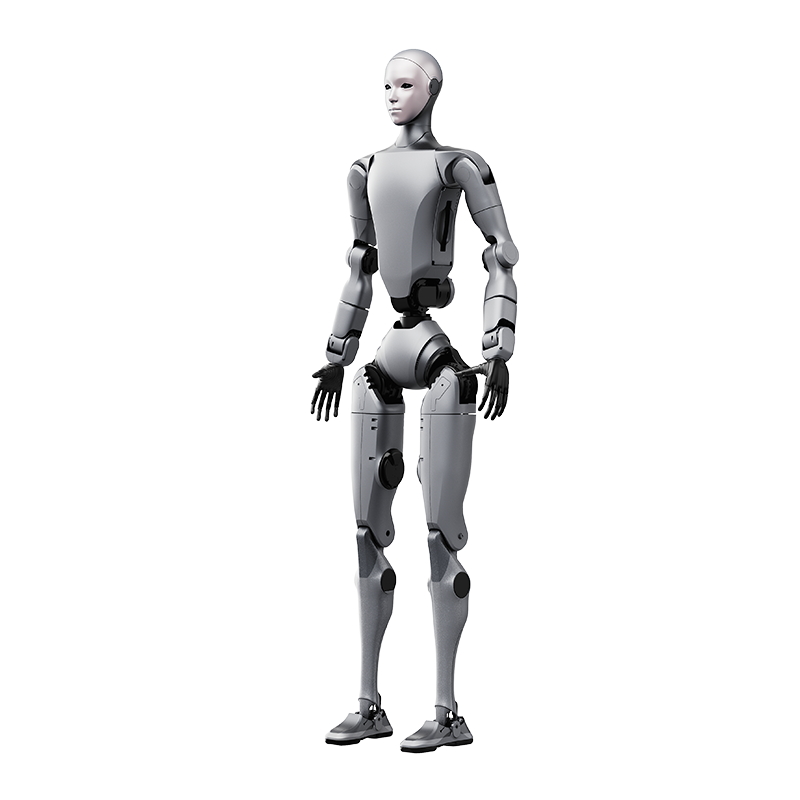
The H2 is the first Unitree platform to reach full human height (1.80–1.82 m, 70 kg) with 31 body DOF, 360 N·m peak leg torque, and a 7 kg rated / 15 kg peak arm payload. The published list price is $29,900 in China (currently contact-sales as of 17 July 2026), $40,900 through the North American partner Toborlife, and $68,900 for the developer-ready EDU tier. The H2 Plus is the only H2 SKU that ships the 2,070 TOPS NVIDIA Jetson Thor compute module as standard. Three caveats matter: the base H2 ships with non-functional placeholder hands, the EDU tier is quote-only, and no independent North American delivery had been verified at the time of writing.
Apptronik Apollo 2 — the only humanoid with a Google DeepMind partnership
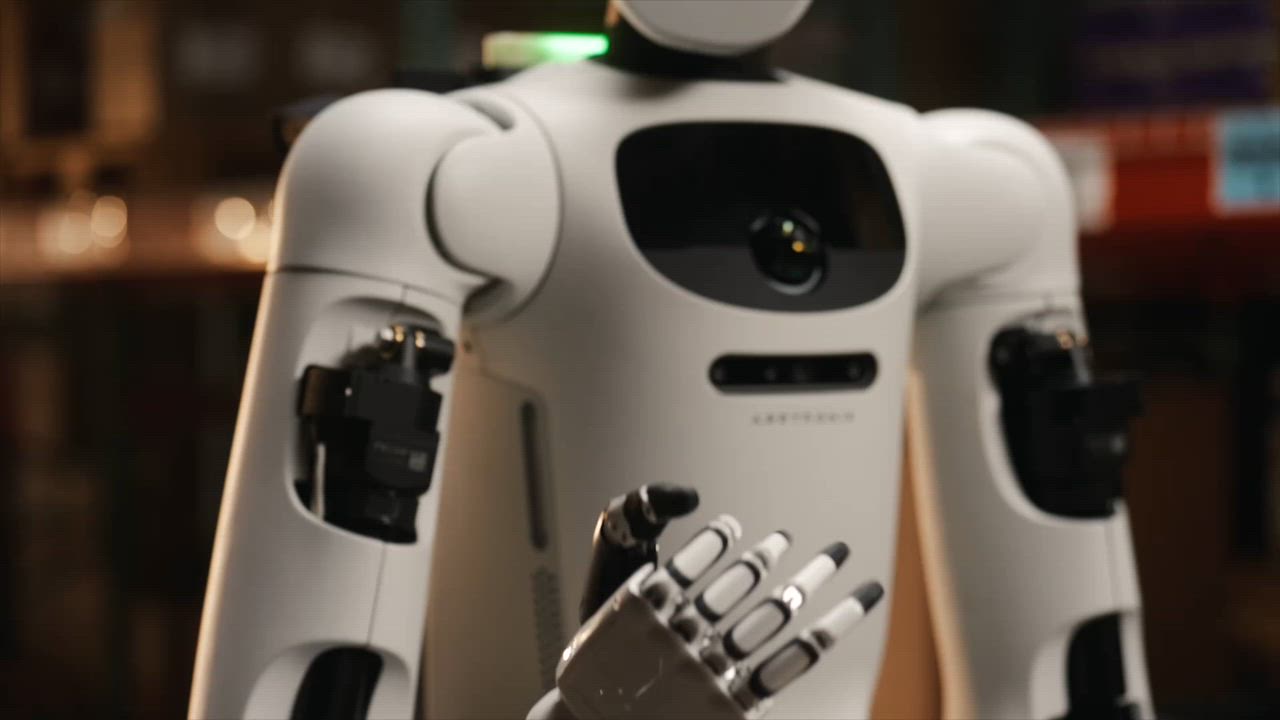
Apollo 2 is the modular successor to the original Apollo that launched in June 2026: 173 cm, 73 kg, 25 kg payload, 4-hour hot-swappable batteries for up to 22 hours of daily operation, NVIDIA Jetson AGX Orin compute, and a choice of bipedal, wheeled, or stationary pedestal configurations. Apptronik has not published a price; the $50,000 at-scale target dates from a 2023 IEEE Spectrum interview with CEO Jeff Cardenas, and the more recent figure of roughly $80,000 per year for high-volume delivery from 2027 comes from investor Howard Morgan via CNBC. Apollo 2 is the headline platform for Google DeepMind's Gemini Robotics 2.0, released 30 July 2026. It is also the only humanoid with active pilots at Mercedes-Benz (moving assembly kits at Berlin and Kecskemét), GXO, and Jabil.
Figure 03 — the first paid commercial-scale humanoid deployment
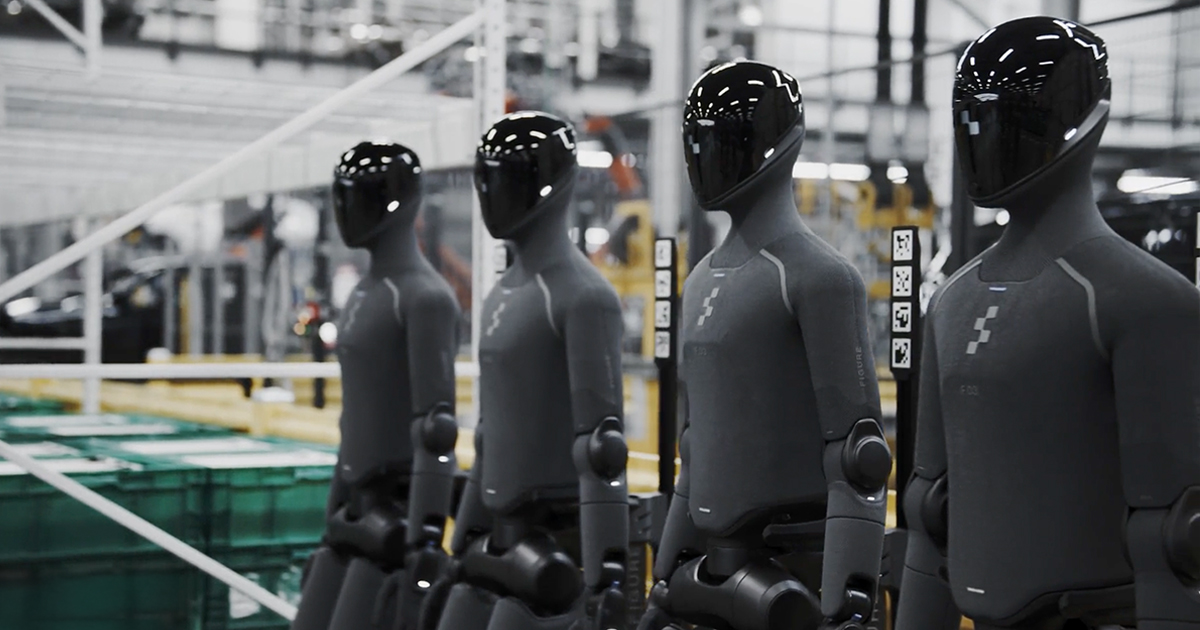
Figure replaced its Figure 02 with the Figure 03 in October 2025. The newer robot is about 9% lighter (~61 kg), adds 2 kW wireless inductive charging, palm cameras, soft textile coverings, 16-DOF hands with fingertip tactile sensors, and a roughly 90% component-cost reduction aimed at the eventual mass-market target. Figure's first paid commercial-scale humanoid deployment began at BMW's Spartanburg plant in South Carolina: an initial fleet of 40 units priced at approximately $25 per robot-operating-hour[2], performing sheet-metal panel handling on the body-shop line at a reported 98.7% success rate. The Figure 02 pilot that preceded it produced more than 30,000 BMW X3s and moved more than 90,000 parts across 1,250 operational hours with placement accuracy above 99% per shift before the fleet was retired in November 2025. Figure has never sold a humanoid to the public, and the $20,000 price often cited in the press is a future mass-production target, not what any Figure 02 or Figure 03 cost in 2026.
Tesla Optimus — the most-watched robot no one outside Tesla can buy

Optimus Gen 2 is 173 cm, 57 kg, with 28 body DOF, 11 DOF per hand, and a 20 kg rated payload on a 2.3 kWh / 52V battery that delivers 6–8 hours of active runtime. The Gen 2 body is now running inside Tesla's own factories. The headline Gen 3 update is the new hand: 22 DOF per hand, 50 total actuators (25 per forearm/hand), all motors relocated into the forearm in a biomimetic tendon-driven design, revealed by Musk on 17 February 2026 with the line "this bot got hands." V3 — Tesla's full-body version of Optimus — added 9 more joints (37 total) per the Q1 2026[16] earnings call, the new Tesla AI5 inference chip (taped out April 2026, roughly 5× the bandwidth of the AI4 / FSD chip) makes the same memory-bandwidth argument that drives the RTX 5080 versus RTX 5090 gap, and Grok from xAI as the on-board voice model. Despite the press cycle, Optimus is not commercially available in 2026: the only verified deployments are inside Tesla's Fremont and Giga Texas factories.
NEURA 4NE-1 Gen 3.5 — the German platform with the highest published payload
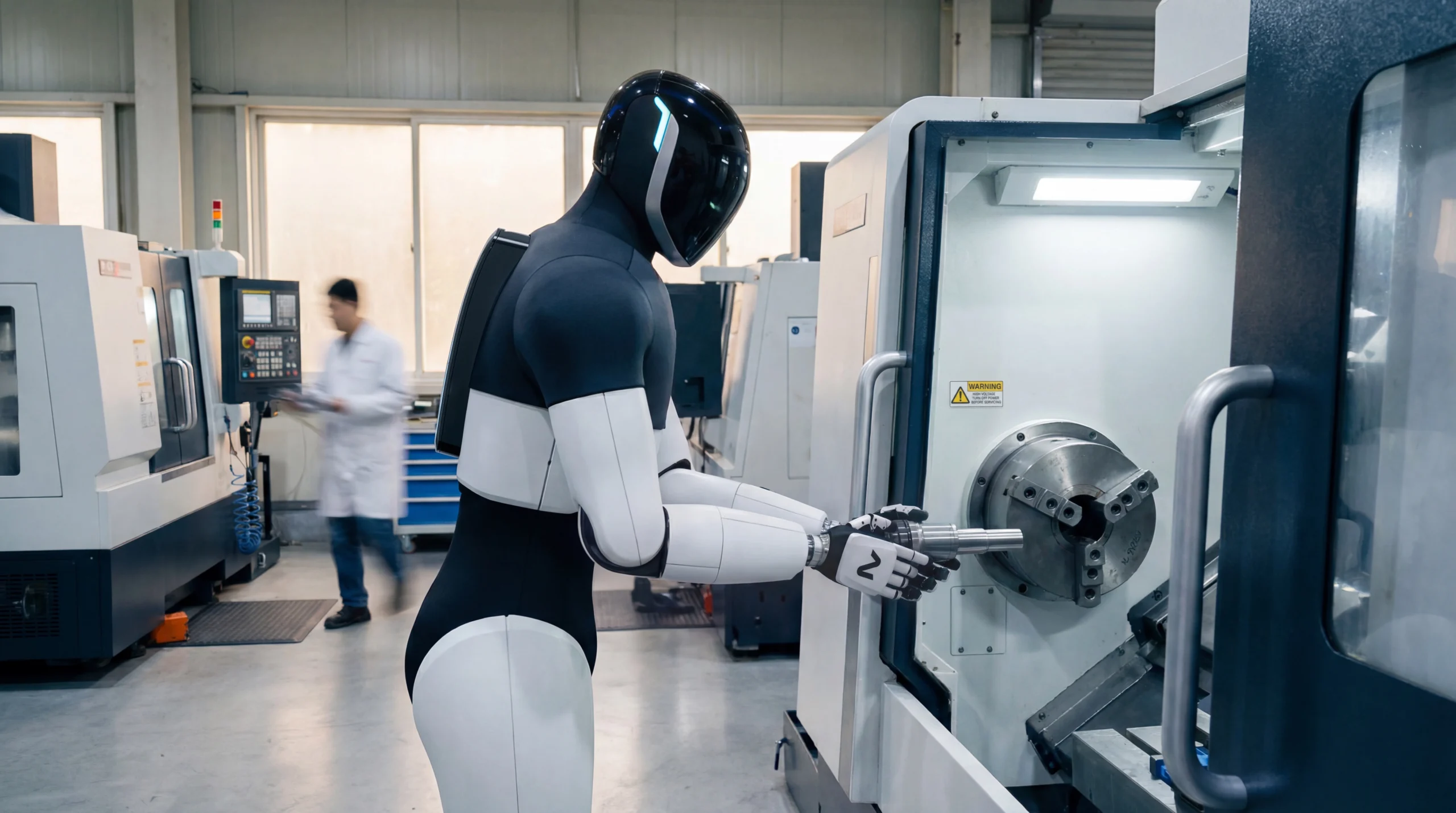
Unveiled at CES 2026, the 4NE-1 Gen 3.5 is the first humanoid from a major European manufacturer with a transparent 2026 price. It is 180 cm, 80 kg, with up to 100 kg of leg-supported peak payload and 15–20 kg of continuous mobile payload, dual hot-swappable batteries good for 6–8 hours per pack, a water-cooled NVIDIA Thor T5000 onboard, and a Studio F.A. Porsche industrial design. The price is €98,000 for 1–19 units, dropping to €60,000 per unit for fleets of 20 or more, with a refundable €100 reservation. The Mini variant is the same lineage at 132 cm, 36 kg, and €19,999 (€29,999 for the Pro with 12-DOF hands), and started shipping in April 2026. The Gen 3.5 ships in late 2026. NEURA is also the only vendor that ships a documented Python / ROS 2 / C++ SDK with the production platform.
Boston Dynamics Atlas (electric) — the most capable demonstration unit
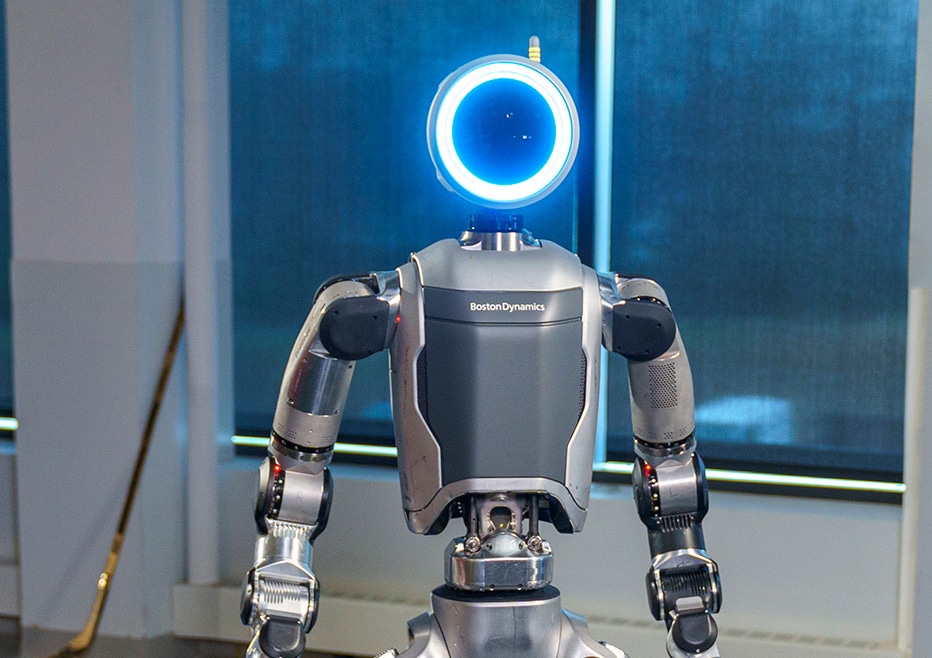
Boston Dynamics retired the hydraulic Atlas in April 2024 and unveiled the all-electric production Atlas at CES 2026 on 5 January during Hyundai's media day. The published spec sheet is the most complete of any humanoid in this comparison: 1.9 m, 90 kg, 56 DOF with fully rotational joints, 2.3 m reach, 50 kg instant / 30 kg sustained / 20 kg one-handed payload, 4-hour battery (2 hours under heavy lifting), 3-minute autonomous battery swap, IP67 ingress protection, operating temperature -20°C to 40°C, and 1.5 m/s walking speed — the fastest of any production humanoid. There is no public price; industry estimates cluster in the $150,000–$420,000 band. The 2026 fleet commitments are Hyundai and Google DeepMind; outside buyers are not on the order book.
1X NEO — the only consumer-priced humanoid taking pre-orders in 2026
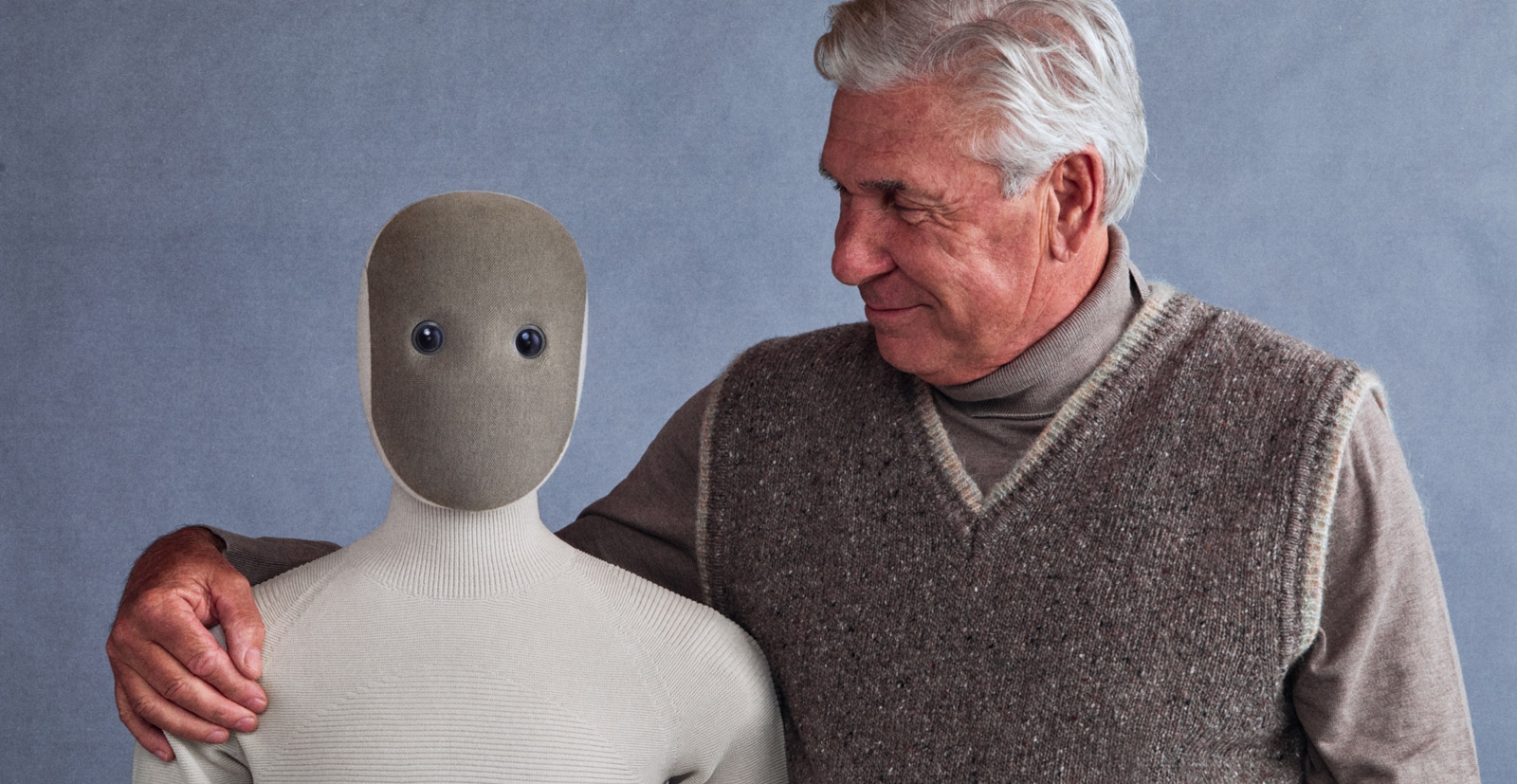
1X opened consumer pre-orders for NEO on 28 October 2025. The price is $20,000 outright (Early Access, three-year warranty, priority delivery in 2026) or $499/month on a subscription that ships later. The reservation deposit is $200 and refundable. The robot is 165 cm, ~30 kg, and the only humanoid on this list designed for the home from the first sketch. As of mid-July 2026, no customer delivery had been independently verified, and 1X's own materials describe first customer shipments in the future tense. The 9 July 2026 announcement of a "new hand on every NEO" is the most recent visible hardware update.
What the Spec Sheets Don't Tell You
Three engineering gaps separate a marketing slide from a procurement-ready humanoid. None of the eight platforms escapes all three.
Peak lift versus continuous mobile payload
The "payload" number on a humanoid spec sheet is the easiest to misread. NEURA 4NE-1 Gen 3.5 lists 100 kg of peak payload, but only in a leg-supported posture; its continuous mobile payload is 15–20 kg. Tesla Optimus lists 20 kg of rated payload with a separate "~68 kg deadlift target" that is explicitly unconfirmed. Atlas distinguishes 50 kg instant, 30 kg sustained, and 20 kg one-handed. Figure 03 publishes a 20 kg figure with no equivalent continuous-mobile qualifier.
| Platform | Peak / one-shot | Continuous mobile (the number a procurement officer should use) |
|---|---|---|
| Atlas (electric) | 50 kg instant / 20 kg one-handed | 30 kg sustained |
| NEURA 4NE-1 Gen 3.5 | 100 kg (leg-supported) | 15–20 kg |
| Apptronik Apollo 2 | 25 kg | 25 kg (no separate qualifier published) |
| Figure 03 | 20 kg | 20 kg (no separate qualifier published) |
| Tesla Optimus Gen 2 / V3 | ~68 kg deadlift target (unconfirmed) | 20 kg rated |
| Unitree H2 | 15 kg | 7 kg rated |
| Unitree G1 (EDU) | 3 kg per hand | 3 kg per hand |
| 1X NEO | Not published | Not published (home humanoid) |
For factory drop-in use, the industry has converged on 15–20 kg of continuous mobile payload — the rough weight of an automotive sub-assembly, a logistics tote, or a kitting basket. The "OSHA sweet spot" phrase used in industry commentary is a metaphor, not a regulatory figure, but it captures the engineering reality: most existing factory workstations are designed around a 15–20 kg handling task, and robots that drop below that bar cannot replace the existing human workflow without re-engineering the line.
Open SDK versus documented SDK
No humanoid platform in 2026 ships a fully open-source, vendor-supported, production-grade SDK across the full stack. Unitree's G1 basic explicitly does not support secondary development; the EDU tier is quote-only. NEURA ships Python, ROS 2, and C++ SDKs with the Gen 3.5 platform and is the closest to "open" in the comparison, but the Gen 3.5 itself does not ship until late 2026. AgiBot's AimRT middleware is partly open but the model itself is closed. Tesla, Figure, Apptronik, Atlas, and 1X are all closed. For an academic lab or a startup building on top of a humanoid, NEURA's SDK posture is the best 2026 option; for a buyer who only needs a turnkey worker, the closed stacks of Figure and Apptronik are the more credible choice because the vendor owns the integration risk.
Marketing runtime versus useful-work runtime
Humanoid battery runtimes are published as constant-load numbers, usually walking on a flat surface with no manipulation. A humanoid that walks for 4 hours on a marketing slide typically delivers 1.5–2 hours of useful tasks involving arm motion, perception, and pauses for human collaboration. The 30% derate is a rule of thumb, not a vendor-published number, but it shows up consistently in operator interviews. The exception is Figure 03's 2 kW wireless charging, which removes the swap-and-charge friction altogether and explains why BMW's commercial deployment runs Figure 03 in shifts rather than on long single-charge cycles.
Which Humanoid to Buy (or Lease) in 2026
There is no "best" humanoid in 2026. The right answer depends on the use case, the procurement budget, and how much of the integration risk the buyer is willing to absorb.
- R&D lab or university: Unitree G1 EDU (cheapest credible open SDK at the lower-spec end) or NEURA 4NE-1 Mini (€19,999, open Python / ROS 2 / C++ SDK, ships in April 2026). The Mini is the better value if you can wait.
- Factory pilot in automotive or logistics, first-world integration risk: Figure 03 RaaS at $25 per operating-hour (no capex, vendor owns hardware) or Apptronik Apollo 2 on a quote-based pilot contract. Both are deployed in paying customer factories today.
- Cost-per-unit at scale, China or global south: AgiBot A2 (10,000+ units shipped, tri-region certified, ~$100K–$190K estimated price band) is the only humanoid in 2026 with proven mass-production volume.
- Heavy-payload industrial (50 kg+ class): Boston Dynamics Atlas (30 kg sustained, 50 kg instant, IP67, 2.3 m reach) is the most capable, but only available through Hyundai and DeepMind pilot commitments. NEURA 4NE-1 Gen 3.5 is the second choice for 100 kg leg-supported peak.
- Home consumer: 1X NEO at $20,000 is the only humanoid taking consumer pre-orders in 2026. There is no second option.
- Tesla Optimus and Sanctuary Phoenix class: wait. Both are demonstration-only in 2026 and neither has a published 2026 commercial price or delivery date.
The single most important procurement signal in 2026 is whether a vendor will put a delivery date and a refundable deposit on the table. Four vendors will: Unitree (G1 in stock, H2 pre-order), 1X ($200 deposit, $20,000 price), NEURA (€100 reservation, €98,000 / €19,999 prices), and to a lesser extent Figure (enterprise RaaS, no up-front capital). The other four — Tesla, Boston Dynamics, AgiBot, and Apptronik — operate on quote-based B2B contracts that are credible but slower to engage.
Frequently Asked Questions
What is the cheapest humanoid robot you can buy in 2026?
The Unitree G1 basic at $13,500 from the official Unitree store. The G1 basic is a 132 cm, 35 kg, 23-DOF research and demonstration platform with no secondary-development support. For a usable development kit with an open SDK, the next step up is the G1 EDU, listed at quote-only, or the NEURA 4NE-1 Mini at €19,999 (~$21,500).
Which humanoid robots have open-source or vendor-supported SDKs in 2026?
NEURA is the only vendor that ships a documented Python / ROS 2 / C++ SDK with the production robot (the 4NE-1 Gen 3.5 and 4NE-1 Mini). Unitree's G1 basic does not support secondary development; the G1 EDU does, but is quote-only. AgiBot's AimRT middleware is partly open. Tesla, Figure, Apptronik, Atlas, and 1X all run closed SDKs. The research-audience takeaway: no humanoid in 2026 ships a fully open, fully documented, vendor-supported SDK across the entire stack.
Which humanoid robots are actually deployed in paying factories today?
Figure 03 is the only humanoid with a paid commercial-scale deployment: 40 units at BMW Spartanburg, $25 per operating-hour, body-shop sheet-metal handling at 98.7% success rate. Apptronik Apollo is in paid pilots at Mercedes-Benz (Berlin and Kecskemét, moving assembly kits), GXO, and Jabil. AgiBot A2 has shipped more than 10,000 units and is the only manufacturer to clear the 10K threshold in 2026. Atlas is committed to Hyundai and Google DeepMind pilot fleets; Tesla Optimus is internal only.
How much does a humanoid robot cost per kilogram of continuous mobile payload?
Using published 2026 list prices and the continuous mobile payload numbers above, the spread is wide. Atlas: ~$5,000–$14,000 per kg of sustained payload (using the industry-estimate $150K–$420K price band and 30 kg sustained). NEURA 4NE-1 Gen 3.5: ~€4,900–€6,500 per kg of continuous payload (€60K–€98K / 15–20 kg). Apptronik Apollo 2: <$2,000 per kg of payload if the $50,000 at-scale target is met. Figure 03 (RaaS): no per-kg capital cost, but at $25 per operating-hour a single Figure 03 over a 2,000-hour annual duty cycle costs $50,000 per year — which puts the per-kg-per-year at roughly $2,500. The cheapest per-kg figure on a unit-purchase basis is still Unitree G1 EDU at a few hundred dollars per kg, but with a 3 kg continuous payload that is a research robot, not a factory worker.
Which humanoid robot is closest to mass production in 2026?
AgiBot is the only humanoid maker that has publicly cleared 10,000 units shipped[17], with the A2 series reaching that milestone in Q1 2026. Unitree is a close second on shipment volume for the G1 platform but has not disclosed a single cumulative number; the G1's twelve configurations and the basic/EDU split make any single volume figure misleading. Tesla's mass production of the Gen 3 hands at Fremont began on 21 January 2026 but the robots are for internal Tesla use only. Figure's BotQ manufacturing plant is the path to its ~$20,000 long-run consumer target but is not yet at scale.
Is the Tesla Optimus for sale? When can a non-Tesla buyer get one?
No. As of August 2026, Optimus is not commercially available outside Tesla. The only verified deployments are inside Tesla's Fremont and Giga Texas factories. Musk's October 2024 price target of $20,000–$30,000[15] has no associated delivery date for external buyers. The Gen 3 hands (22 DOF, 50 actuators per robot) entered Tesla-internal mass production at Fremont on 21 January 2026.
For any organisation evaluating a humanoid robot in 2026, the single most useful filter is the four-quadrant framework above. If a vendor will not put a 2026 price and a delivery date on the table, the robot is in the demonstration quadrant and the rest of the spec sheet is signal, not commitment. The eight platforms compared here split cleanly: three can be ordered today (Unitree G1, AgiBot A2, with caveats on the H2), two are reservable for 2026 delivery (1X NEO, NEURA 4NE-1), two are pilot-only (Apptronik Apollo 2[6], Figure 03 enterprise RaaS), and two are demonstration-only (Tesla Optimus, Boston Dynamics Atlas). That breakdown, not the headline-grabbing DOF or payload numbers, is the real 2026 humanoid robot market.
Cited sources
- Figure 03 at BMW press release
- Figure 03 RaaS pricing
- Unitree G1 product page
- Unitree H2 review (RoboZaps)
- Unitree G1 EDU pricing
- Apptronik Apollo 2 product page
- Apptronik Apollo review (RoboZaps)
- 1X NEO home robot page
- 1X NEO review (RoboZaps)
- NEURA 4NE-1 product page
- NEURA 4NE-1 review (RoboZaps)
- Boston Dynamics Atlas spec sheet PDF
- Boston Dynamics Atlas product page
- Tesla Optimus hardware specs
- Tesla Optimus availability 2026
- AgiBot A2 coverage
- AgiBot brand page
- BMW Spartanburg press release
- NVIDIA Jetson Thor T5000
- Optimus Wikipedia
Cited sources
- Figure 03 at BMW press release
- Figure 03 RaaS pricing
- Unitree G1 product page
- Unitree H2 review (RoboZaps)
- Unitree G1 EDU pricing
- Apptronik Apollo 2 product page
- Apptronik Apollo review (RoboZaps)
- 1X NEO home robot page
- 1X NEO review (RoboZaps)
- NEURA 4NE-1 product page
- NEURA 4NE-1 review (RoboZaps)
- Boston Dynamics Atlas spec sheet PDF
- Boston Dynamics Atlas product page
- Tesla Optimus hardware specs
- Tesla Optimus availability 2026
- AgiBot A2 coverage
- AgiBot brand page
- BMW Spartanburg press release
- NVIDIA Jetson Thor T5000
- Optimus Wikipedia

Loading comments…