

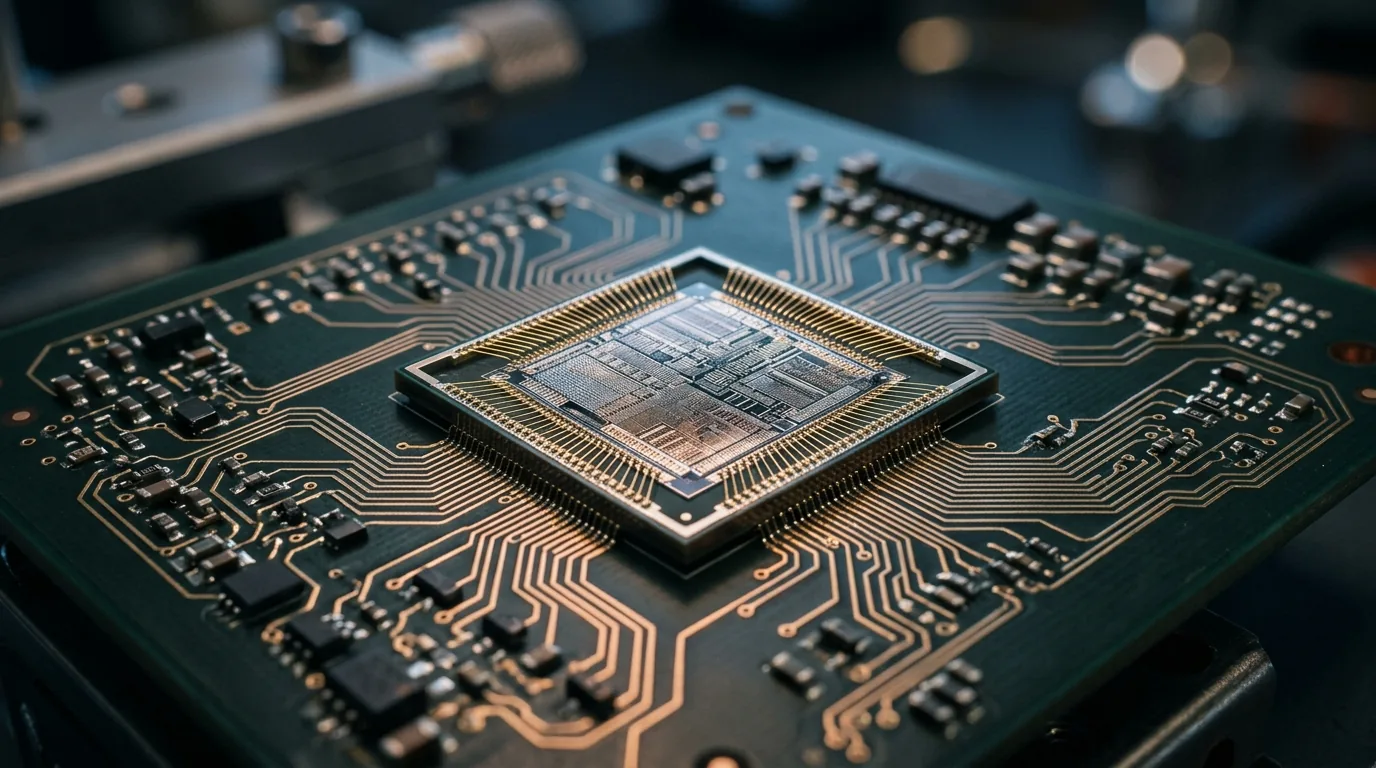
On September 21, 2026, Microchip Technology Incorporated officially completed its acquisition of Hailo, the Tel Aviv-based developer of high-efficiency edge artificial intelligence processors. The closing finalizes a definitive agreement signed on July 24, 2026, transferring Hailo’s neural accelerator intellectual property, vision processor lines, and comprehensive software compiler stack directly into Microchip’s embedded systems ecosystem.
For decades, Microchip (NASDAQ: MCHP) built an industrial computing empire anchored by 8-bit PIC and AVR microcontrollers, 32-bit SAM microprocessors, and radiation-tolerant PolarFire FPGAs. However, as deep neural networks and multimodal vision models migrated from cloud hyperscale centers to battery-operated field devices, the company faced a widening architectural gap. Machine learning at the extreme edge requires tens of trillions of operations per second (TOPS) executed within sub-5-watt thermal envelopes—a performance threshold traditional microcontroller cores and general-purpose DSPs cannot deliver. By absorbing Hailo’s structure-driven dataflow silicon, Microchip establishes an immediate, production-ready defense against the edge computing dominance of NVIDIA, NXP, and Texas Instruments.
The $1.2B Unicorn Fire Sale: Inside Hailo’s Liquidity Crisis and Restructuring

While Microchip executives heralded the transaction as a strategic triumph, the acquisition concludes a turbulent corporate chapter for one of Israel’s most prominent semiconductor startups. Founded in 2017 by veterans of the Israel Defense Forces' elite intelligence technology units—including Chief Executive Officer Orr Danon—Hailo raised approximately $340 million across multiple funding rounds. Its backers included prominent venture funds and strategic industrial entities such as the Zisapel family's RAD Group, OurCrowd, and Delek Automotive.
By early 2024, Hailo achieved a unicorn valuation exceeding $1.2 billion, buoyed by the commercial success of its Hailo-8 accelerator and lucrative original equipment manufacturer (OEM) partnerships across automotive advanced driver-assistance systems (ADAS) and industrial automation. However, the capital-intensive reality of advanced semiconductor fabrication soon collided with broader venture capital retrenchment. A prospective public listing via a Special Purpose Acquisition Company (SPAC) collapsed amid volatile equity markets, triggering severe cash flow pressures.
Facing unsustainable operational burn rates and mounting tape-out expenditures for its next-generation 16nm and 7nm silicon, Hailo relied on emergency debt facilities provided by automotive distributor Delek Automotive in early 2026. In June 2026, Hailo enacted a drastic restructuring, terminating nearly 50% of its global workforce to narrow its focus onto "Physical AI," edge robotics, and automated vision pipelines. Recognizing that Hailo’s proprietary architecture remained technically unmatched despite its corporate distress, Microchip Chief Executive Officer and Chair Steve Sanghi—who returned to lead the semiconductor giant in late 2024—moved swiftly to acquire the company at a substantial discount to its prior valuation.
Architecture Teardown: Why Structure-Driven Dataflow Crushes GPU Bottlenecks
To understand why Microchip pursued Hailo rather than licensing generic neural processing unit (NPU) cores from Arm or Synopsys, hardware architects must examine the physical limitations of edge inferencing. Conventional computing architectures rely on the classic Von Neumann model: instructions and data reside in external memory (such as LPDDR4 or DDR5) and are shuttled back and forth over a shared bus to arithmetic logic units (ALUs). In edge GPUs like NVIDIA's Jetson series, more than 70% to 80% of total system energy is consumed not by computing matrix multiplications, but by the electrical power required to move weights and activations between off-chip DRAM and the processor core.
Hailo bypassed this "memory wall" by developing a patented structure-driven dataflow architecture. Rather than utilizing a fixed processor that continuously fetches instructions to process static weights, Hailo's silicon maps the topological layers of a neural network directly onto a heterogeneous, two-dimensional array of localized compute, memory, and control elements:
- Spatially Distributed Local Memory: Deep neural network weights are distributed across thousands of ultra-dense on-chip SRAM memory blocks situated adjacent to dedicated multiply-accumulate (MAC) units, entirely eliminating off-chip DRAM accesses during standard vision inferencing.
- Data-Driven Execution: Compute units operate asynchronously. When activation tensors arrive at a node via the on-chip interconnect, the node fires, processes the mathematical transformation, and streams the output directly to the subsequent physical layer.
- High Resource Utilization: By customizing routing paths to match the specific connectivity of target neural network graphs (such as YOLOv8, MobileNet, or ResNet-50), Hailo achieves practical silicon compute utilization rates between 75% and 90%, compared to the 20% to 40% typical of mobile GPUs.
The resulting portfolio spans three distinct processor tiers:
- Hailo-8 / Hailo-8L: Delivering up to 26 TOPS of INT8 compute within a 2.5-watt power budget (achieving an efficiency exceeding 10 TOPS/Watt). The entry-level Hailo-8L provides 13 TOPS and powers commercial add-in boards such as the Raspberry Pi 5 AI Kit.
- Hailo-10H: Designed for generative AI and on-device multimodal execution, offering 40 TOPS of INT4 (or 20 TOPS INT8) compute. Equipped with an integrated LPDDR4/4X memory interface, it processes quantized small language models—such as Llama-3.2 3B or Mistral 7B—directly at the edge.
- Hailo-15 Vision SoCs: Monolithic systems-on-chip combining a quad-core Arm Cortex-A53 host processor, a hardware image signal processor (ISP) capable of processing dual 4K60 video streams with high dynamic range (HDR), and an integrated 20-TOPS NPU for smart surveillance and autonomous mobile robots (AMRs).
Edge AI Silicon Benchmark Matrix: Hailo-8 vs. The Competition
In fanless industrial controllers, sealed IP67 robotic housings, and pole-mounted traffic cameras, thermal dissipation dictates system viability. While hyperscale data center processors prioritize raw throughput regardless of power—as analyzed in our examination of Marvell's 2nm optical interconnects—edge devices must operate under strict thermal envelopes. The table below illustrates how Hailo-8 compares directly against primary edge silicon competitors:
| Platform / Silicon | Architecture Type | Peak Compute (INT8) | Typical Power (TDP) | Energy Efficiency | External Memory Dependency | Primary Deployment Focus |
|---|---|---|---|---|---|---|
| Microchip / Hailo-8 | Structure-Driven Dataflow | 26 TOPS | 2.5 W | ~10.4 TOPS/W | None (Self-contained on-chip SRAM) | Smart cameras, drones, industrial automation, edge add-on cards |
| NVIDIA Jetson Orin Nano (8GB) | Ampere GPU (1024 CUDA + 32 Tensor Cores) | 40 TOPS (sparse) / 20 TOPS (dense) | 7 W – 15 W | ~1.3 – 2.8 TOPS/W | Mandatory 8GB 128-bit LPDDR5 | Robotics prototyping, complex multi-modal autonomous systems |
| NXP i.MX 95 | Arm Cortex-A55 + eIQ Neutron NPU | up to 10 TOPS | 3.5 W – 6 W | ~1.7 – 2.8 TOPS/W | Mandatory LPDDR4X/LPDDR5 | Automotive domain controllers, industrial HMIs, IoT gateways |
| Texas Instruments AM68A | Arm Cortex-A72 + C7x DSP / MMA NPU | 8 TOPS | 3 W – 5 W | ~1.6 – 2.6 TOPS/W | Mandatory 32-bit LPDDR4 | Surveillance cameras, machine vision, commercial ADAS |
| Microchip PolarFire SoC (VectorBlox) | Multi-Core RISC-V + Low-Power FPGA Fabric | 2 – 4 TOPS | 2 W – 4 W | ~1.0 TOPS/W | Optional LPDDR4 / On-chip eSRAM | Mission-critical avionics, defense, deterministic functional safety |
The operational divide highlighted in this data explains Microchip's strategic urgency. While Microchip’s existing PolarFire SoC FPGA platform equipped with the VectorBlox neural accelerator SDK delivers exceptional determinism and radiation tolerance for aerospace applications, it cannot match the raw 26-TOPS density required for contemporary real-time vision pipelines. Hailo provides a 10x throughput multiplier without requiring active cooling fans or oversized heat sinks.
The Software Toolchain Convergence: Fusing Hailo DFC with MPLAB Harmony

In the embedded semiconductor industry, silicon architecture is only as viable as its software compiler. Hardware companies frequently fail because their proprietary compilers cannot reliably ingest standard open-source deep learning models. Hailo’s established software infrastructure—developed over seven years and refined across more than 10,000 active developers—was a primary asset in Microchip's acquisition calculus.
The software pipeline centers upon the Hailo Dataflow Compiler (DFC). The compiler takes pre-trained models from TensorFlow, PyTorch, or ONNX formats and executes a three-phase optimization:
- Model Parsing & Graph Pruning: Translates arbitrary neural network computational graphs into an internal intermediate representation (IR), identifying opportunities for layer fusion and dead-weight removal.
- Advanced Quantization: Applies post-training quantization (PTQ) or quantization-aware training (QAT) to reduce 32-bit floating-point weights to INT8 or INT4 precision with minimal loss of accuracy. For the Hailo-10H, the compiler incorporates state-of-the-art GPTQ and QuaROT algorithms specifically engineered to preserve coherence in large language models.
- Resource Allocation & Place-and-Route: Generates a spatial allocation map, configuring the internal routing switches and assigning layers directly to physical compute clusters. The output is a single, compiled Hailo Executable Format (.HEF) binary file.
Microchip's software roadmap focuses on integrating the Hailo execution runtime directly into its flagship MPLAB® Harmony v3 framework and Linux4Microchip industrial distributions. Embedded software developers will be able to invoke compiled `.HEF` neural models via standard C/C++ API calls directly from host firmware running on Microchip SAM9X microprocessors or SAMA7 MPUs, with video streams handled seamlessly through Hailo’s pre-integrated TAPPAS GStreamer multimedia pipelines.
Developer Ecosystem and Physical AI: The Future of the Raspberry Pi AI Kit

A critical question following the acquisition centers on Hailo's grassroots developer ecosystem. In mid-2024, the Raspberry Pi Foundation selected the Hailo-8L to power the official $70 Raspberry Pi AI Kit, bringing hardware-accelerated computer vision to tens of thousands of hobbyists, academic researchers, and industrial prototype builders. Microchip executive leadership confirmed that existing distribution channels, hardware modules (M.2 Key M, Key B+M, and Mini PCIe form factors), and open-source documentation will remain fully supported.
Looking forward, the combined entity is positioned to capture the burgeoning market for Physical AI. As explored in our comparative analysis of humanoid robotics platforms, autonomous physical systems require localized perception models to calculate real-time kinematics, detect obstacles, and parse environmental hazards without the latency, bandwidth cost, or security vulnerabilities of cloud offloading.
By pairing Hailo’s high-throughput vision silicon with Microchip’s safety-rated motor controllers, CAN bus transceivers, and secure hardware authentication elements (such as the CryptoAuthentication ATECC608 family), Microchip can offer a unified, single-vendor hardware stack for industrial robotics, drone navigation, and automated optical inspection (AOI). For an embedded industry navigating the transition toward pervasive machine intelligence, Microchip’s acquisition of Hailo signals that the battle for edge AI supremacy will be won not in distant server farms, but milliwatt by milliwatt on the factory floor.
Frequently Asked Questions
What are the financial terms of Microchip’s acquisition of Hailo?
Microchip Technology did not publicly disclose the exact purchase price for Hailo. However, corporate filings indicate the transaction will not have a material impact on Microchip’s near-term financial results. Industry reports confirm the sale occurred at a significant valuation discount compared to Hailo’s peak $1.2 billion unicorn valuation in 2024, following a failed SPAC merger and a 50% workforce restructuring in June 2026.
How does Hailo-8 compare to the NVIDIA Jetson Orin Nano?
The Hailo-8 delivers 26 TOPS of INT8 inference while consuming only 2.5 watts of power (over 10 TOPS/Watt), operating entirely without external DRAM during active vision tasks. The NVIDIA Jetson Orin Nano delivers up to 40 sparse TOPS (20 dense TOPS) but requires between 7 and 15 watts of power, relies on external LPDDR5 memory, and requires active cooling fans in most commercial deployments.
Will Microchip continue to support the Raspberry Pi AI Kit?
Yes. Microchip has explicitly committed to maintaining continuity across Hailo’s active commercial product lines, module form factors (including M.2 and Mini PCIe cards), software tools, and developer channels, which include the Hailo-8L module utilized by the Raspberry Pi AI Kit.
Can Hailo processors run generative AI and Large Language Models (LLMs)?
While the Hailo-8 is optimized primarily for convolutional neural networks and vision transformers, the newer Hailo-10H processor is specifically designed to execute generative AI, multimodal vision-language models (VLMs), and small language models (such as Llama-3.2 3B) at the edge, utilizing 40 TOPS of INT4 compute and an integrated LPDDR4/4X memory bus.
How does Hailo's structure-driven dataflow architecture work?
Instead of executing sequential software instructions using a centralized GPU or CPU arithmetic unit, Hailo’s architecture maps individual neural network layers onto an array of physical compute and distributed on-chip SRAM memory elements. Data flows through the chip along dedicated hardware routing paths, virtually eliminating the energy-intensive process of fetching data to and from off-chip DRAM.


Loading comments…